Understanding why AI agents are more flexible for dynamic business and manufacturing environments.
Traditional automation has been widely used in manufacturing and business systems for many years.
It is useful for repetitive and stable tasks. However, modern environments are becoming more dynamic, data-driven, and complex.
This is where AI agents can provide new value.
1. What is Traditional Automation?
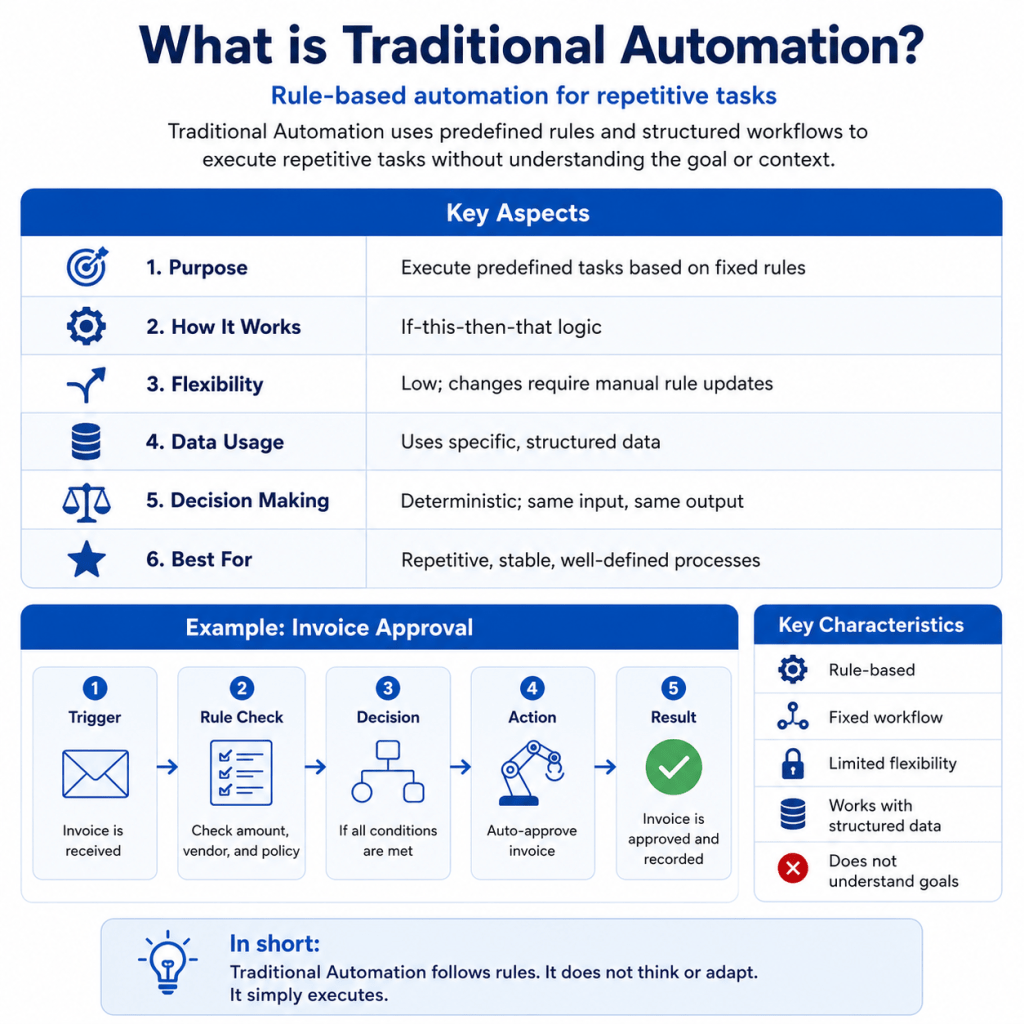
Traditional automation usually follows predefined rules.
For example:
If condition A happens, then system B performs action C.
This works well when the process is clear, stable, and predictable.
However, it becomes less flexible when situations change or when decisions require information from multiple systems.
2. What Makes AI Agents Different?
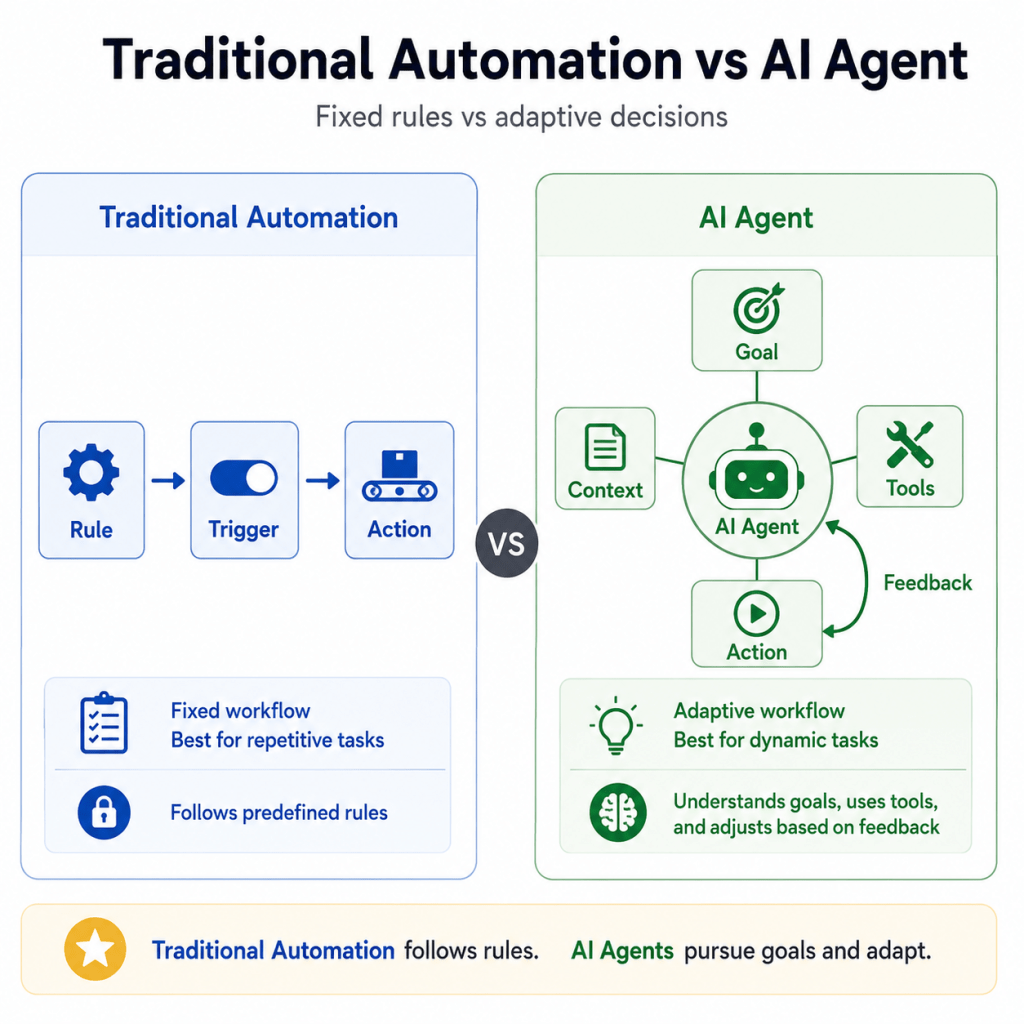
An AI agent can understand a goal, collect context, use tools, analyze information, and support decisions.
Instead of only following fixed rules, it can respond to changing situations.
This makes AI agents more suitable for complex tasks such as abnormality analysis, production decision support, and quality investigation.
3. Simple Comparison
Traditional automation is rule-driven.
AI agents are goal-driven.
Traditional automation executes predefined steps.
AI agents can reason, plan, and adapt based on context.
4. Manufacturing Example
If a machine alarm occurs, traditional automation may trigger a fixed response.
An AI agent can check sensor data, production records, maintenance history, and standard operating procedures before recommending the next action.
This creates a more flexible and evidence-based decision process.
5. Why This Matters
Manufacturing environments often change due to materials, machines, operators, schedules, and customer requirements.
A fixed rule may not cover every situation.
AI agents can help teams make better decisions when the situation is uncertain or complex.
Summary
Traditional automation is useful for stable tasks.
AI agents are useful for dynamic and context-rich problems.
In simple terms, traditional automation follows rules, while AI agents support adaptive decisions.
 Willie Lin | Smart Manufacturing, Agentic AI & Decision Intelligence
Leave a comment