Alerts Are Only the Beginning
Many factories already have alert systems.
When a machine stops, a sensor value exceeds a threshold, or yield suddenly drops, the system can trigger an alarm.
However, the real challenge begins after the alert appears.
Who should investigate the problem?
Which production line is affected?
Is it a material issue, equipment issue, process issue, or operator-related issue?
Should the factory stop the line, adjust parameters, notify maintenance, or continue production under monitoring?
In many manufacturing environments, alert systems can detect that something is wrong, but they often cannot explain why it happened or what should be done next.
This is where AI agents become valuable.
AI agents are not just another layer of automation. They help factories move from warning signals to informed decisions and practical actions.
1. Why Traditional Alerts Are Not Enough
Traditional alert systems are usually designed to monitor specific conditions.
For example, they may trigger an alarm when:
- Equipment temperature exceeds a limit
- Yield drops below a target
- Cycle time becomes too long
- Defect counts increase
- A machine enters downtime
- Production output falls behind schedule
These alerts are useful, but they are often limited.
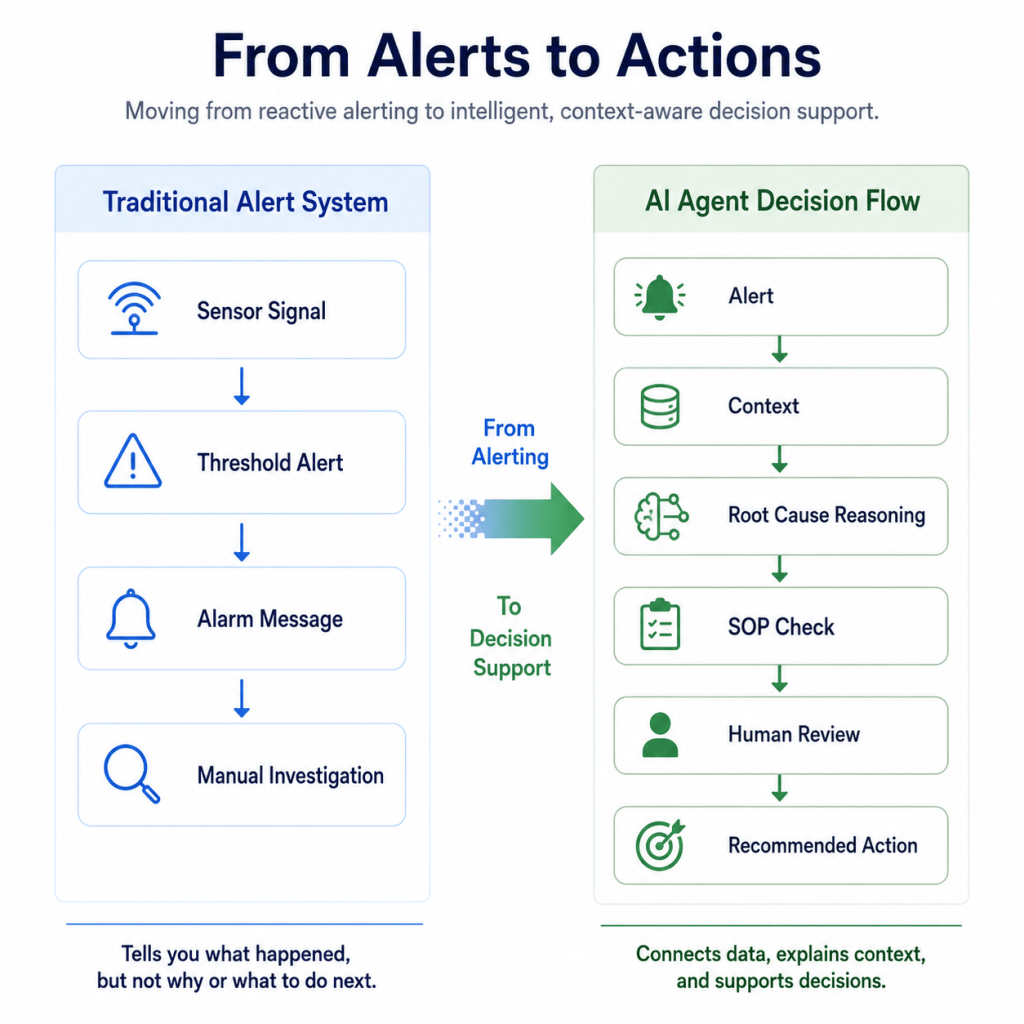
Most alert systems can answer:
What happened?
But they usually cannot fully answer:
Why did it happen?
What is the business impact?
What should we do next?
In practice, this creates several common problems.
First, too many alerts can overwhelm engineers and operators. If every abnormal signal becomes an alarm, people may not know which issue should be handled first.
Second, alerts are often disconnected from business context. A yield drop on a high-priority customer order may be more urgent than the same yield drop on a low-volume trial order.
Third, alerts may not connect data across systems. A production issue may involve MES data, ERP orders, equipment signals, material batches, maintenance records, and quality inspection results. If these data sources are not connected, root cause analysis becomes slow and fragmented.
As a result, the factory may know that a problem exists, but still struggle to make a fast and confident decision.
2. What an AI Agent Adds
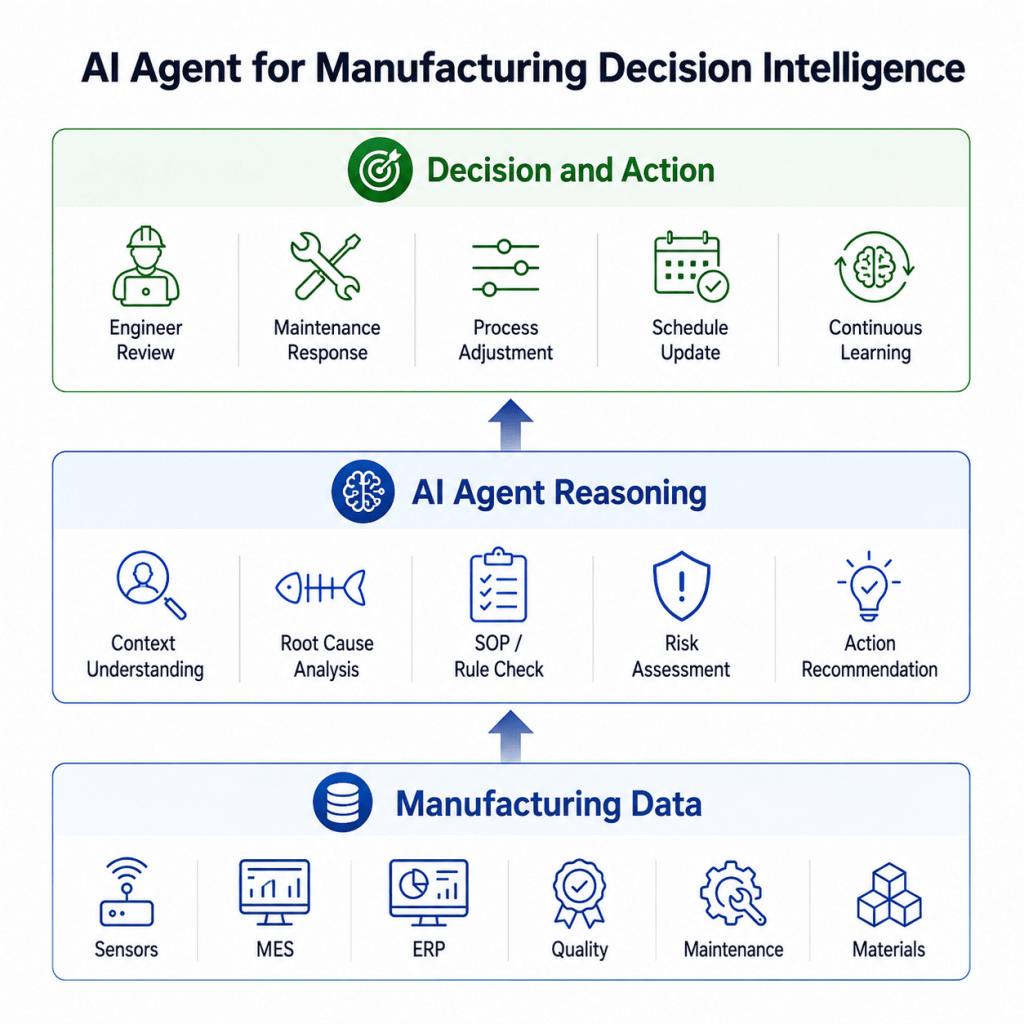
An AI agent can extend the value of alert systems by connecting data, context, reasoning, and action.
Instead of simply saying:
“Yield is below target.”
An AI agent can help answer:
“Yield dropped on Line 3 during the night shift. The affected product uses material batch B-204. Similar defects appeared in the last two hours. The likely causes are soldering temperature drift or material variation. The recommended next step is to check process parameters, compare batch history, and request engineer review before continuing mass production.”
This is the difference between an alert and a decision-support workflow.
An AI agent can add five important capabilities.
2.1 Data Connection
The agent can collect data from multiple systems, such as:
- Sensor data
- Machine status
- MES production records
- ERP work orders
- Quality inspection results
- Material batch information
- Maintenance history
This gives the agent a broader view of the production situation.
2.2 Context Understanding
The agent does not only look at raw numbers. It also considers the context behind the numbers.
For example:
- Which product is being produced?
- Which line is affected?
- Which shift was running?
- Was there a recent changeover?
- Was a new material batch used?
- Is the order urgent?
- Is the defect pattern new or recurring?
Context helps the agent understand whether an alert is truly critical or only a temporary variation.
2.3 Root Cause Reasoning
An AI agent can compare current signals with historical cases, production rules, and process knowledge.
It can help identify possible causes, such as:
- Equipment drift
- Material variation
- Operator setup issue
- Process parameter instability
- Maintenance delay
- Inspection abnormality
- Scheduling pressure
The agent does not replace engineers. Instead, it helps narrow down the possible causes faster.
2.4 SOP and Rule Alignment
In manufacturing, decisions cannot rely only on prediction. They must also follow standard operating procedures, quality rules, safety requirements, and business constraints.
An AI agent can check whether a recommended action is aligned with:
- SOPs
- Quality control rules
- Maintenance policies
- Production priority
- Customer delivery requirements
- Human approval rules
This makes the recommendation more reliable and easier to review.
2.5 Action Recommendation
The most important value of an AI agent is that it can support the next action.
For example, the agent may recommend:
- Continue production with monitoring
- Inspect a specific machine
- Compare material batch history
- Escalate to maintenance
- Slow down the line temporarily
- Reassign production to another line
- Ask an engineer to approve before execution
This moves the factory from passive alert handling to active decision support.
3. A Simple Manufacturing Example
Imagine a factory producing electronic assemblies.
During production, the yield on Line 5 suddenly drops by 5%.
A traditional alert system may show:
“Yield below threshold.”
This tells the team that something is wrong, but it does not explain the situation.
An AI agent can go further.
It may check:
- Recent defect patterns
- Equipment temperature trend
- Soldering process parameters
- Material batch changes
- Operator shift information
- Product model history
- Similar past events
- Maintenance records
- Current production priority
After reviewing the context, the agent may generate a structured recommendation:
“Yield dropped by 5% on Line 5 after material batch M-782 was introduced. Similar defect patterns occurred in two previous batches with higher soldering variation. Equipment temperature also shows a mild upward drift. Recommended action: inspect soldering temperature settings, compare batch M-782 with previous stable batches, and request process engineer review before continuing high-volume production.”
This output is much more useful than a simple alarm.
The agent helps the team understand:
- What happened
- Where it happened
- Why it may have happened
- What data supports the explanation
- What action should be considered
- Who should review the decision
This is how AI agents transform alerts into decisions.
4. From Reactive Response to Decision Intelligence
The key change is not only technical. It is also managerial.
Traditional alert systems support reactive response. They help people notice problems.
AI agents support decision intelligence. They help people understand problems, evaluate options, and take better actions.
This creates a more complete decision flow:
- Detect the abnormal signal
- Connect the relevant data
- Understand the production context
- Analyze possible root causes
- Check rules and SOPs
- Recommend possible actions
- Request human review when needed
- Execute or monitor the decision
- Learn from the outcome
This flow is especially important in smart manufacturing because production decisions often involve multiple trade-offs.
For example:
- Stopping a line may protect quality but reduce output.
- Continuing production may protect delivery but increase defect risk.
- Reassigning work orders may reduce delay but increase changeover cost.
- Adjusting machine parameters may improve yield but require engineering approval.
An AI agent can help evaluate these trade-offs more systematically.
5. Why Human Review Still Matters
AI agents should not blindly execute every recommendation.
In manufacturing, some decisions have high operational impact. For example:
- Stopping a production line
- Changing process parameters
- Releasing questionable products
- Reassigning urgent orders
- Escalating supplier quality issues
These decisions should involve human review.
A practical AI agent system should support different levels of control:
- Low-risk issues: AI can summarize and monitor
- Medium-risk issues: AI can recommend actions for human confirmation
- High-risk issues: AI can analyze options, but humans make the final decision
This human-in-the-loop design helps ensure that AI agents are not only intelligent, but also safe, accountable, and trustworthy.
6. Business Value of Moving from Alerts to Actions
The business value of AI agents does not come from generating more alarms.
It comes from improving the quality and speed of decision-making.
A well-designed AI agent can help manufacturers:
- Reduce investigation time
- Prioritize critical issues
- Improve root cause analysis
- Support faster maintenance response
- Reduce repeated defects
- Improve yield stability
- Improve production continuity
- Strengthen cross-functional communication
- Make decisions more traceable
For managers, this means better visibility.
For engineers, this means faster diagnosis.
For operators, this means clearer guidance.
For the enterprise, this means better alignment between production data and business decisions.
Conclusion: The Future Is Not More Alerts, but Better Decisions
Manufacturing does not need more disconnected alarms.
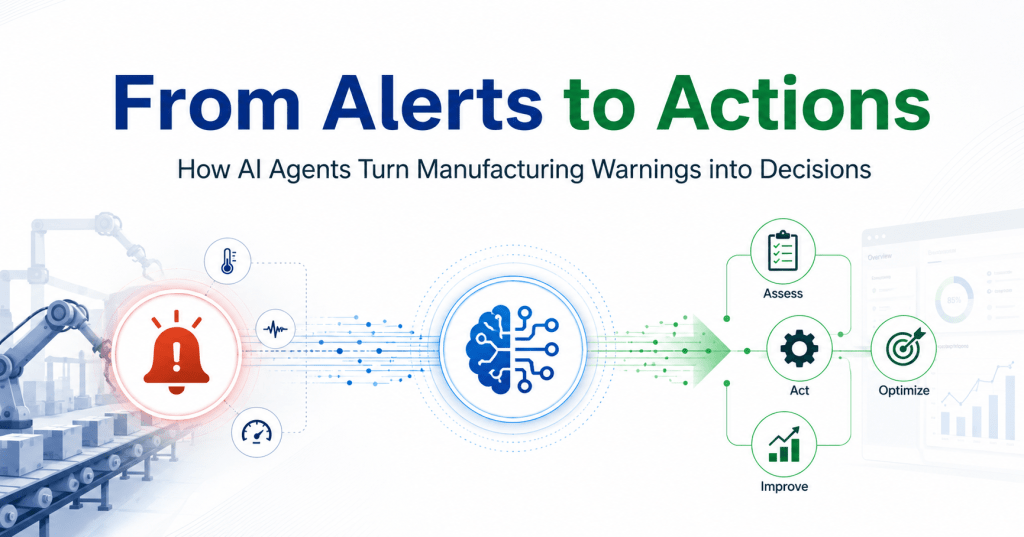
It needs systems that can connect signals, understand context, reason through possible causes, and support practical actions.
This is the real value of AI agents.
An alert tells us that something happened.
An AI agent helps us understand why it happened, what it means, and what we should do next.
In smart manufacturing, the future of AI is not only prediction. It is decision intelligence.
AI agents help factories move from alerts to actions, from data to context, and from warnings to better business decisions.
 Willie Lin | Smart Manufacturing, Agentic AI & Decision Intelligence
Leave a comment