The Real Challenge of Scheduling Is Change
The hardest part of production scheduling is not creating a plan.
The real challenge is responding when reality changes.
In many manufacturing environments, a production schedule may look reasonable at the beginning of the day. Orders are assigned, machines are allocated, materials are prepared, and delivery targets are clear. However, once production starts, conditions often change.
A machine may stop unexpectedly.
A material shipment may be delayed.
A key operator may be absent.
An urgent order may need to be inserted.
Yield may suddenly fall below expectation.
At that moment, the original schedule is no longer enough.
Traditional scheduling is often built as a fixed plan. But modern manufacturing needs something more adaptive. It needs the ability to evaluate changing conditions, compare options, and support better decisions in real time.
This is where AI agents can create value.
AI agents can help manufacturers move from static planning to dynamic scheduling decisions.
1. Why Traditional Scheduling Struggles
Traditional production scheduling methods are useful when conditions are stable. They help planners assign jobs, balance capacity, and organize production flow.
However, many traditional scheduling systems are based on assumptions that are difficult to maintain in real factory operations.
They often assume that:
- machines will remain available,
- materials will arrive as expected,
- labor capacity will be sufficient,
- production quality will remain stable,
- and priorities will not change significantly.
In practice, these assumptions are often violated.
1.1 Equipment Disruptions
Unexpected equipment downtime is one of the biggest challenges in scheduling. Even a short machine stoppage can affect downstream work orders, labor allocation, and customer delivery commitments.
1.2 Labor Shortage or Skill Mismatch
A schedule may look feasible on paper, but if the required operator or technician is unavailable, the plan may no longer be executable.
1.3 Material Delays
Production schedules depend heavily on material availability. If a critical component is delayed, the planned order sequence may need to be changed immediately.
1.4 Urgent Orders and Priority Changes
Manufacturers often receive rush orders, engineering changes, or customer priority requests. These changes can disrupt existing plans and force replanning.
1.5 Yield Fluctuation and Quality Issues
If yield drops or defect rates rise, the available output may not match the planned output. This affects capacity assumptions and may require schedule adjustment.
The core weakness of traditional scheduling is that it is often designed as a one-time planning exercise.
But manufacturing is not static.
It is a dynamic environment where conditions evolve continuously.
2. What AI Agents Can Do
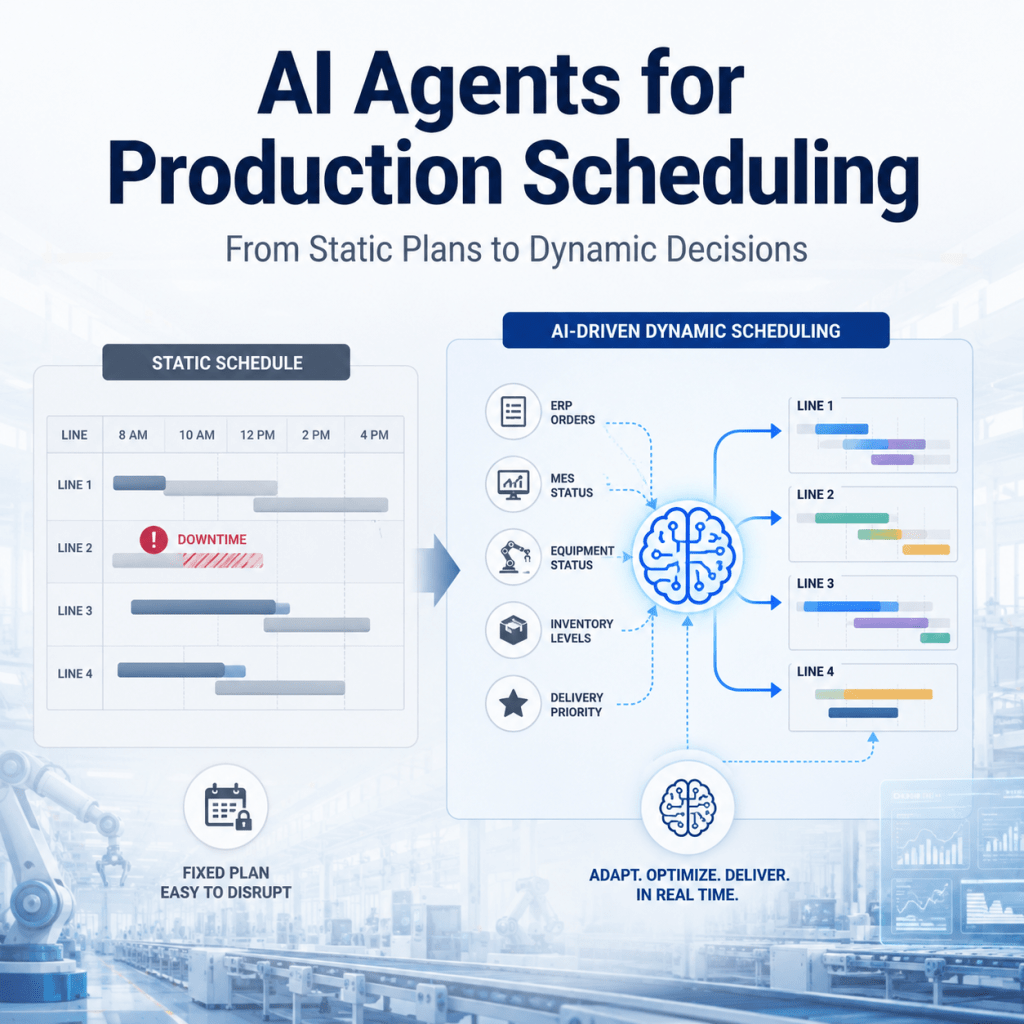
AI agents can help scheduling become more adaptive by integrating multiple sources of real-time operational information and supporting decision-making when conditions change.
Unlike traditional scheduling tools that mainly generate an initial plan, AI agents can continuously interpret the current production situation and recommend the next best action.
A scheduling AI agent can integrate information such as:
- ERP orders
- MES production status
- equipment condition and machine availability
- material and inventory status
- delivery priority and due dates
- labor availability
- quality and yield signals
- maintenance events
This broader data view allows the AI agent to move beyond static planning and toward dynamic operational coordination.
2.1 Real-Time Visibility
AI agents can monitor the current state of production and identify changes that affect the schedule, such as machine downtime, late materials, or lower-than-expected output.
2.2 Context-Aware Reasoning
The AI agent can interpret not only what has changed, but also what that change means.
For example:
- Which orders are affected?
- Which customers are at risk?
- Which lines have alternative capacity?
- Which work orders can be delayed with minimal impact?
- Which jobs should be protected because of high priority?
2.3 Faster Rescheduling Support
Instead of asking planners to manually assess every disruption, the AI agent can generate options quickly.
For example:
- transfer part of the workload to another line,
- resequence jobs,
- delay low-priority orders,
- split work orders,
- or escalate delivery risk to supply chain or customer-facing teams.
2.4 Cross-Functional Coordination
Scheduling is not only a production issue. It often affects procurement, maintenance, warehouse operations, and customer commitments.
AI agents can help notify the right functions when rescheduling affects broader business operations.
3. Decision Logic: How AI Agents Support Scheduling Decisions
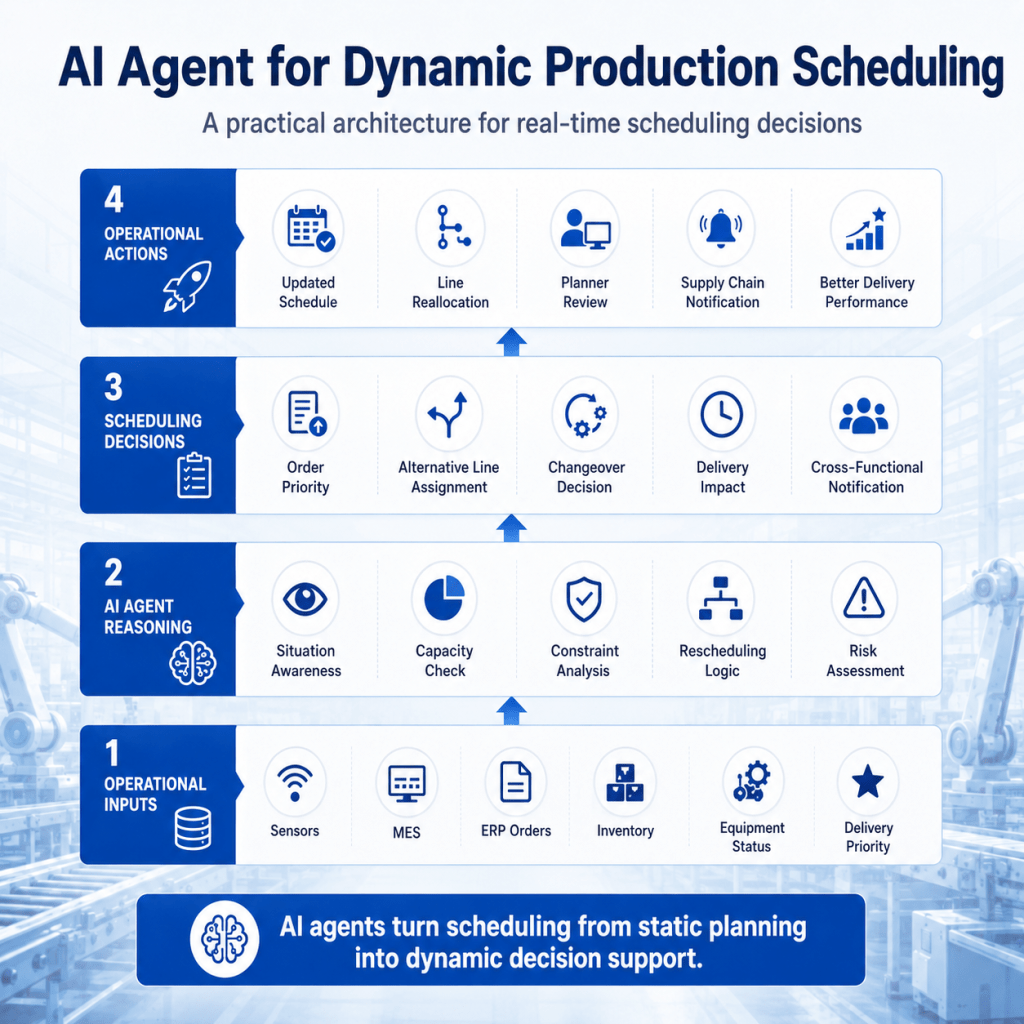
The value of an AI agent in scheduling is not only that it sees data faster. Its real value is that it helps structure scheduling decisions more intelligently.
When production conditions change, an AI agent can help answer key operational questions.
3.1 Which Work Order Should Be Processed First?
The AI agent can evaluate priorities by considering:
- due date urgency,
- customer importance,
- downstream impact,
- material readiness,
- line availability,
- and production feasibility.
This allows scheduling decisions to be based on more than just a fixed queue.
3.2 Which Line Can Take Over the Work?
If a machine or line becomes unavailable, the AI agent can identify alternative production lines based on:
- capability matching,
- tooling and setup requirements,
- available capacity,
- operator availability,
- and likely quality impact.
3.3 Is a Changeover Worth It?
Moving a job to another line may reduce delivery risk, but it may also increase setup time or reduce efficiency.
The AI agent can help compare these trade-offs instead of making scheduling decisions based only on immediate urgency.
3.4 Will Delivery Be Affected?
A schedule disruption does not always create a delivery problem, but some disruptions do.
The AI agent can estimate whether the new production condition is likely to affect shipment timing or customer commitments.
3.5 Who Needs to Be Notified?
If the schedule adjustment affects materials, customer communication, or cross-line coordination, the AI agent can suggest whether supply chain, production control, or sales teams should be informed.
This turns scheduling into a connected decision process rather than a local line-level adjustment.
4. A Simple Manufacturing Case
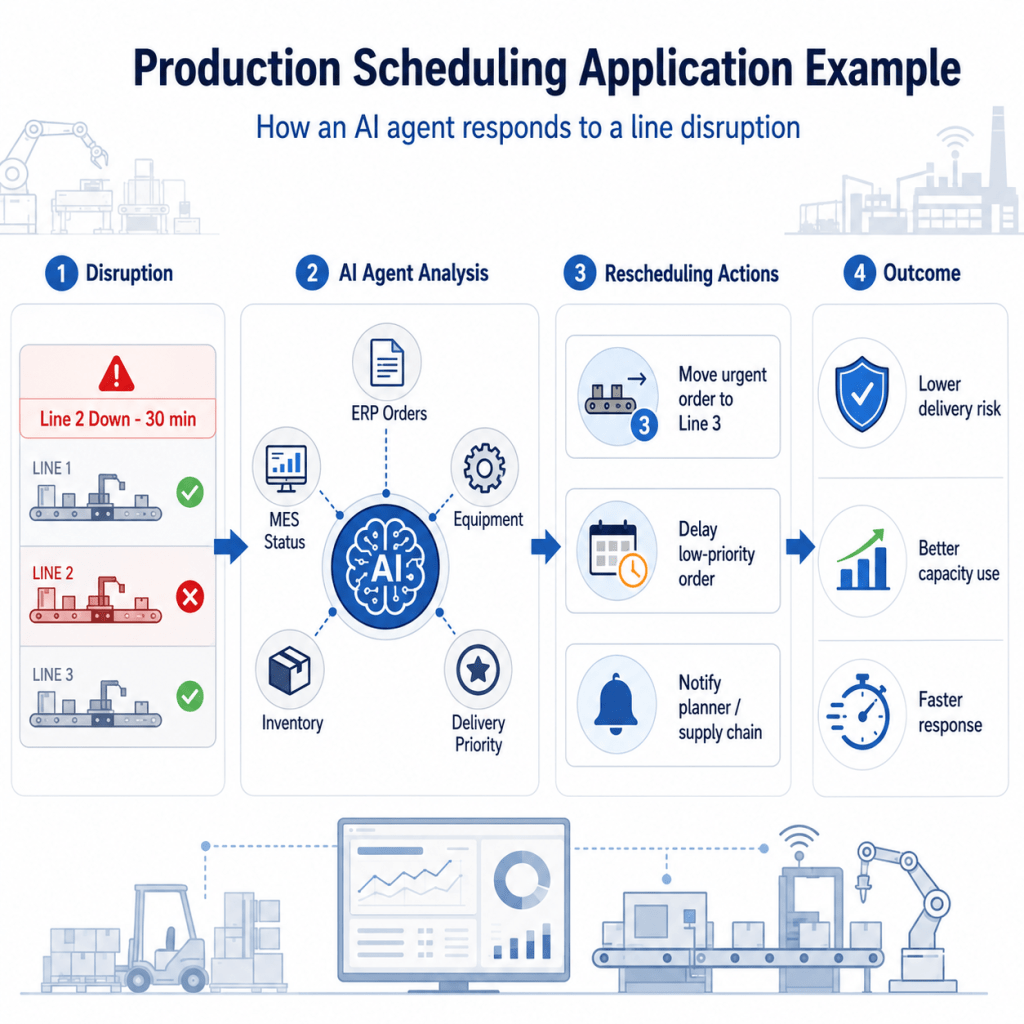
Consider a factory running multiple production lines.
One line unexpectedly stops for 30 minutes due to equipment failure.
Under a traditional scheduling approach, the planner must manually check which work orders are affected, review capacity on other lines, estimate delay risk, and decide whether replanning is necessary.
This process may take time, especially if the planner needs to gather information from different systems.
Now imagine the same situation with an AI scheduling agent.
The agent detects the line stoppage and immediately checks:
- which work orders are currently assigned to that line,
- their due dates and customer priorities,
- whether another line has compatible capability,
- whether materials are available on the alternative line,
- whether transferring work would require a major changeover,
- and whether the disruption is likely to affect delivery performance.
After evaluating the options, the agent may recommend:
- moving part of the affected work order to another available line,
- keeping the remaining order on the original line once it recovers,
- delaying a lower-priority order to protect a more urgent customer order,
- and notifying production control about potential schedule impact.
This is not just a data report.
It is a structured scheduling recommendation.
The AI agent helps the organization move quickly from disruption detection to operational response.
5. From Static Planning to Dynamic Decision Support
The most important idea is this:
Scheduling should not be treated only as a static planning task.
It should be treated as a dynamic decision-support process.
A static schedule answers:
What should we do if everything goes as planned?
A dynamic scheduling system answers:
What should we do now, given what is happening in the factory?
This shift is important because manufacturing performance depends not only on plan quality, but also on response quality.
A good initial plan is valuable.
But when disruption occurs, the ability to respond intelligently often matters even more.
AI agents improve this response capability by helping organizations:
- see changes faster,
- evaluate options more systematically,
- make trade-offs more clearly,
- coordinate across functions,
- and protect delivery and production continuity more effectively.
6. Business Value of AI Agents in Scheduling
AI agents for production scheduling can create value in several ways.
6.1 Better Responsiveness
They help manufacturers react faster when production conditions change.
6.2 Higher Schedule Stability
They reduce the impact of disruptions by supporting earlier and better adjustments.
6.3 Improved Delivery Performance
They help protect customer commitments by identifying risks before delays become severe.
6.4 Better Use of Capacity
They help allocate work more effectively across available lines and resources.
6.5 Stronger Decision Quality
They allow scheduling decisions to consider data, context, and business priorities together.
6.6 Improved Cross-Functional Communication
They help ensure that the right teams are informed when schedule changes affect materials, warehouse activity, or customer delivery.
This makes scheduling more than an operational task. It becomes part of a broader decision intelligence capability.
7. The Role of Human Review
Even with strong AI support, production scheduling should not become fully uncontrolled automation.
In many cases, rescheduling decisions affect multiple business trade-offs, such as:
- throughput,
- cost,
- setup time,
- delivery reliability,
- quality risk,
- and customer commitments.
For routine adjustments, AI recommendations may be executed automatically under defined rules.
For medium- or high-impact changes, human review remains important.
For example, if rescheduling requires:
- a major line change,
- customer delivery reprioritization,
- emergency overtime,
- or deviation from normal planning rules,
then production planners or managers should review the recommendation before execution.
This makes the AI agent a decision-support partner rather than an uncontrolled decision maker.
Conclusion: AI Agents Turn Scheduling into a Dynamic Decision System
Traditional production scheduling is often built around fixed assumptions.
But factory operations are full of disruptions, uncertainty, and change.
Equipment failures, labor shortages, material delays, urgent orders, and yield fluctuations can quickly make an initial plan outdated.
That is why the future of scheduling is not just better planning.
It is better decision-making.
AI agents help manufacturers move from static schedules to dynamic scheduling systems by integrating real-time data, understanding operational context, evaluating alternatives, and recommending practical actions.
They help answer not only what was planned, but what should be done now.
This is the real value of AI agents in production scheduling.
They transform scheduling from a one-time plan into a dynamic decision system that supports resilience, responsiveness, and better operational outcomes.
 Willie Lin | Smart Manufacturing, Agentic AI & Decision Intelligence
Leave a comment