The Real Question Is Not Whether AI Can Answer
When companies introduce AI agents into manufacturing, the most important question is not simply:
Can the AI generate an answer?
The more important question is:
Can we trust its judgment?
This distinction matters.
In manufacturing, AI recommendations may influence production schedules, equipment responses, quality decisions, material handling, maintenance priorities, and customer delivery commitments. A wrong recommendation is not just a technical mistake. It may create production disruption, quality risk, inventory confusion, or delivery delay.
This is why trustworthiness is critical.
A trustworthy AI agent is not only accurate. It must also be explainable, traceable, controlled, and reviewable.
In other words, the value of an AI agent is not only that it can provide an answer, but that people can understand, evaluate, approve, and improve that answer.
1. Trust Is Not Only Accuracy
Accuracy is important.
If an AI model frequently makes wrong predictions, it will not be useful in real manufacturing operations. However, accuracy alone is not enough to make an AI agent trustworthy.
A model may have high accuracy in testing, but still create risk in practice if users cannot understand how it makes recommendations or whether its output follows operational rules.
In manufacturing, companies also need to ask several practical questions:
- What data did the AI agent use?
- Which production line, work order, product, or material batch was involved?
- What evidence supports the recommendation?
- Does the recommendation follow SOPs and quality rules?
- Is the action within an approved operating range?
- Who reviewed or approved the recommendation?
- Can the decision be traced later?
- What happens if the recommendation is wrong?
- How can the system learn from human feedback?
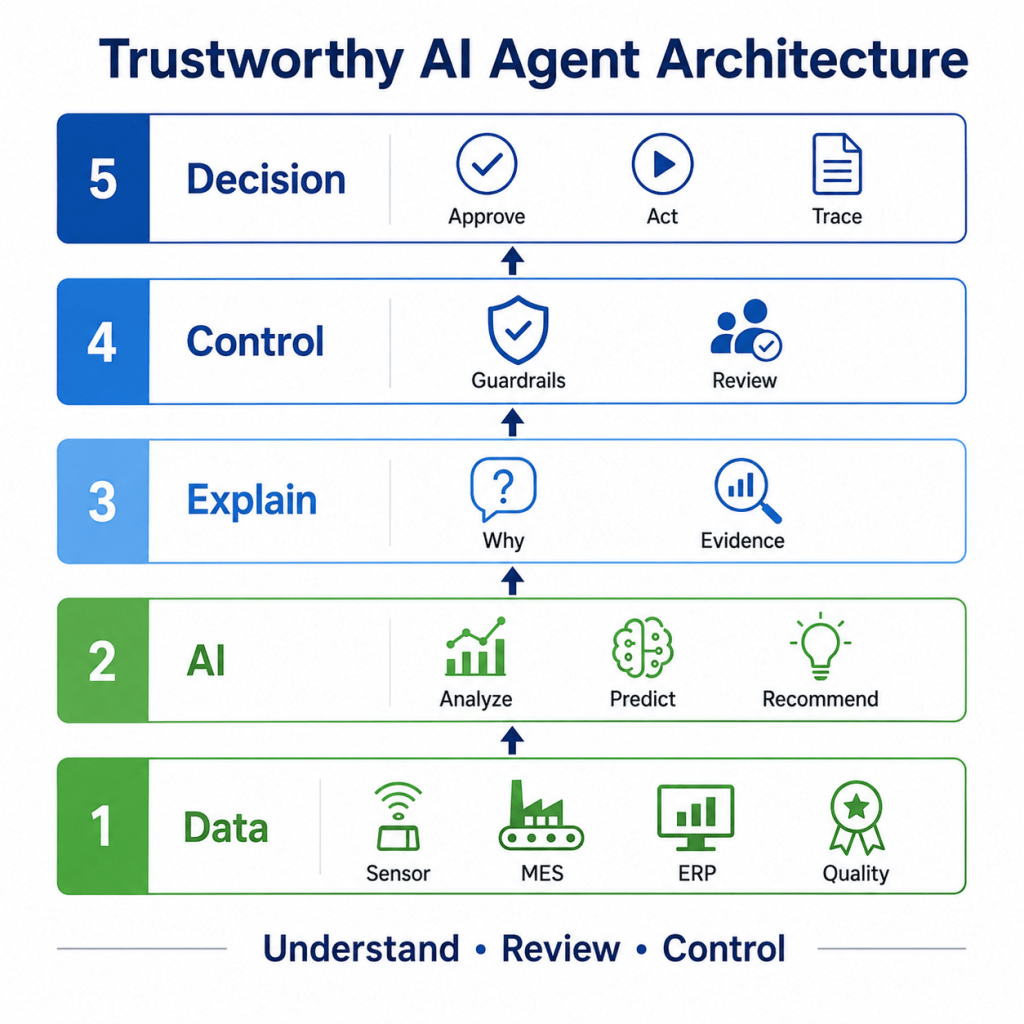
These questions show that trust is not just a model performance issue.
Trust is a system design issue.
A trustworthy AI agent must connect prediction with context, explanation, governance, and accountability.
2. Why Trust Matters More in Manufacturing
Manufacturing environments are different from many digital-only environments.
In a digital service, an AI error may lead to a wrong suggestion, a poor user experience, or a failed search result. In manufacturing, an AI error may affect physical operations.
For example, an AI agent may recommend:
- slowing down a machine,
- stopping a production line,
- changing process parameters,
- reassigning work orders,
- escalating a maintenance task,
- holding a material batch,
- or warning that delivery may be delayed.
Each of these recommendations has operational consequences.
A decision that protects quality may reduce throughput.
A decision that protects delivery may increase defect risk.
A decision that improves short-term output may increase machine stress.
A decision that reallocates work may create changeover cost or warehouse pressure.
Because manufacturing decisions involve trade-offs, AI agents must be designed to support responsible decision-making, not only fast automation.
This is why trustworthiness becomes a core requirement.
3. Five Elements of Trustworthy AI Agents
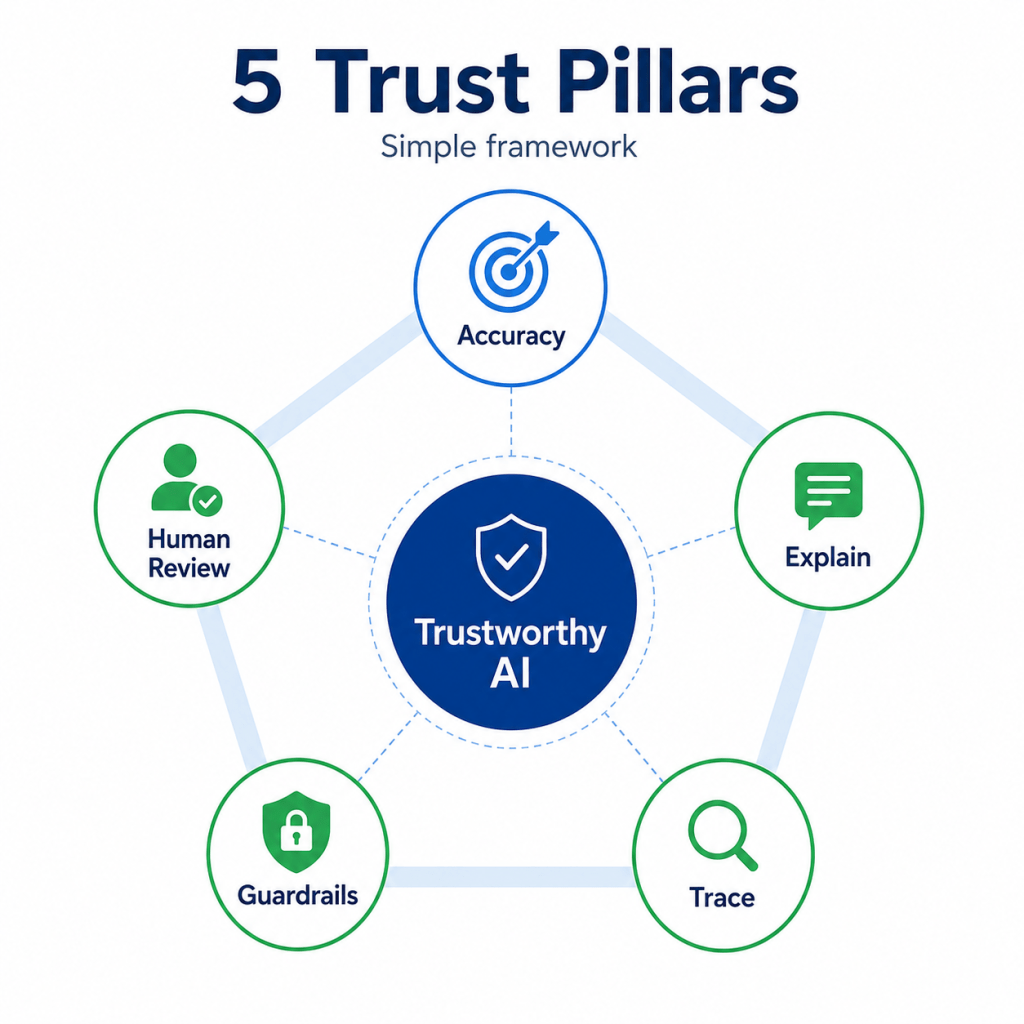
A trustworthy AI agent in manufacturing should include five important elements:
- Accuracy
- Explainability
- Traceability
- Guardrails
- Human control
These five elements work together. If one element is missing, trust becomes weaker.
3.1 Accuracy: The Foundation of Reliable Recommendations
Accuracy means that the AI agent can make useful predictions, classifications, or recommendations based on data.
In manufacturing, this may include:
- detecting abnormal yield patterns,
- predicting equipment risk,
- identifying possible root causes,
- forecasting delivery delay,
- estimating production impact,
- or recommending maintenance priority.
Accuracy is the foundation, but it should be evaluated carefully.
A high overall accuracy score may hide important weaknesses. For example, a model may perform well on normal cases but poorly on rare but critical abnormal events.
That is why manufacturing AI should not only look at general accuracy. It should also consider:
- false alarms,
- missed abnormal cases,
- performance by product type,
- performance by production line,
- performance under changing conditions,
- and impact on operational decisions.
A trustworthy AI agent must be accurate enough to support real work, especially in high-impact situations.
3.2 Explainability: Users Need to Understand Why
Explainability means that the AI agent can show why it made a recommendation.
In manufacturing, users do not only want to know the final answer. They need to know the reasoning behind it.
For example, instead of saying:
“Reduce machine speed.”
A more trustworthy AI agent should explain:
“Yield has decreased over the past two hours. Machine temperature is above the recent baseline. Similar historical cases were associated with speed-related instability. SOP suggests conservative operation when yield and temperature drift occur together.”
This type of explanation helps engineers and managers understand whether the recommendation makes sense.
Explainability is especially important when AI recommendations affect:
- product quality,
- equipment settings,
- delivery commitments,
- or production continuity.
A clear explanation helps users validate the AI output and decide whether to accept, modify, or reject the recommendation.
3.3 Traceability: Every Decision Should Leave a Record
Traceability means that the system can record how an AI recommendation was generated and what happened afterward.
In manufacturing, traceability is important because decisions often need to be reviewed later.
A trustworthy AI agent should record:
- input data used by the agent,
- time of the recommendation,
- affected production line or work order,
- detected abnormal signals,
- explanation or evidence,
- SOP or rule references,
- risk level,
- reviewer or approver,
- final action taken,
- and outcome after execution.
This creates a decision history.
Traceability helps answer important questions:
- Why was this action recommended?
- Who approved it?
- Was the action aligned with policy?
- Did the action improve the situation?
- Should the rule or model be updated?
Without traceability, AI decisions become difficult to audit and difficult to improve.
With traceability, AI agents become part of a learning and governance process.
3.4 Guardrails: AI Needs Boundaries
Guardrails are rules and constraints that prevent AI agents from making unsafe, non-compliant, or unreasonable recommendations.
In manufacturing, AI agents should not operate without boundaries.
For example, guardrails may define:
- process parameter limits,
- safety constraints,
- quality control rules,
- approval requirements,
- escalation conditions,
- customer priority rules,
- maintenance policies,
- and change management procedures.
Guardrails help ensure that AI recommendations stay within acceptable operational limits.
For example, an AI agent may recommend adjusting machine speed, but the system should check:
- Is the speed adjustment within the approved range?
- Does the SOP allow this action?
- Is engineer approval required?
- Will the action affect product qualification?
- Does the action create downstream risk?
Guardrails make AI agents more controllable.
They also reduce the risk of over-automation.
3.5 Human Control: Critical Decisions Need Oversight
Human control means that people remain involved in important decision points.
This does not mean humans must approve every AI recommendation. Instead, the level of human involvement should depend on operational risk.
A practical design may include:
- Low-risk actions: AI can recommend or execute automatically.
- Medium-risk actions: AI recommends, and humans confirm.
- High-risk actions: AI analyzes options, but humans make the final decision.
This risk-based approach allows companies to benefit from AI speed while keeping control over high-impact decisions.
Human control is especially important when decisions involve:
- stopping a line,
- changing process parameters,
- releasing questionable products,
- reassigning urgent orders,
- or affecting customer delivery.
In these cases, AI should support human judgment, not replace it.
A trustworthy AI agent should make human decisions faster, better informed, and more consistent.
4. A Manufacturing Example
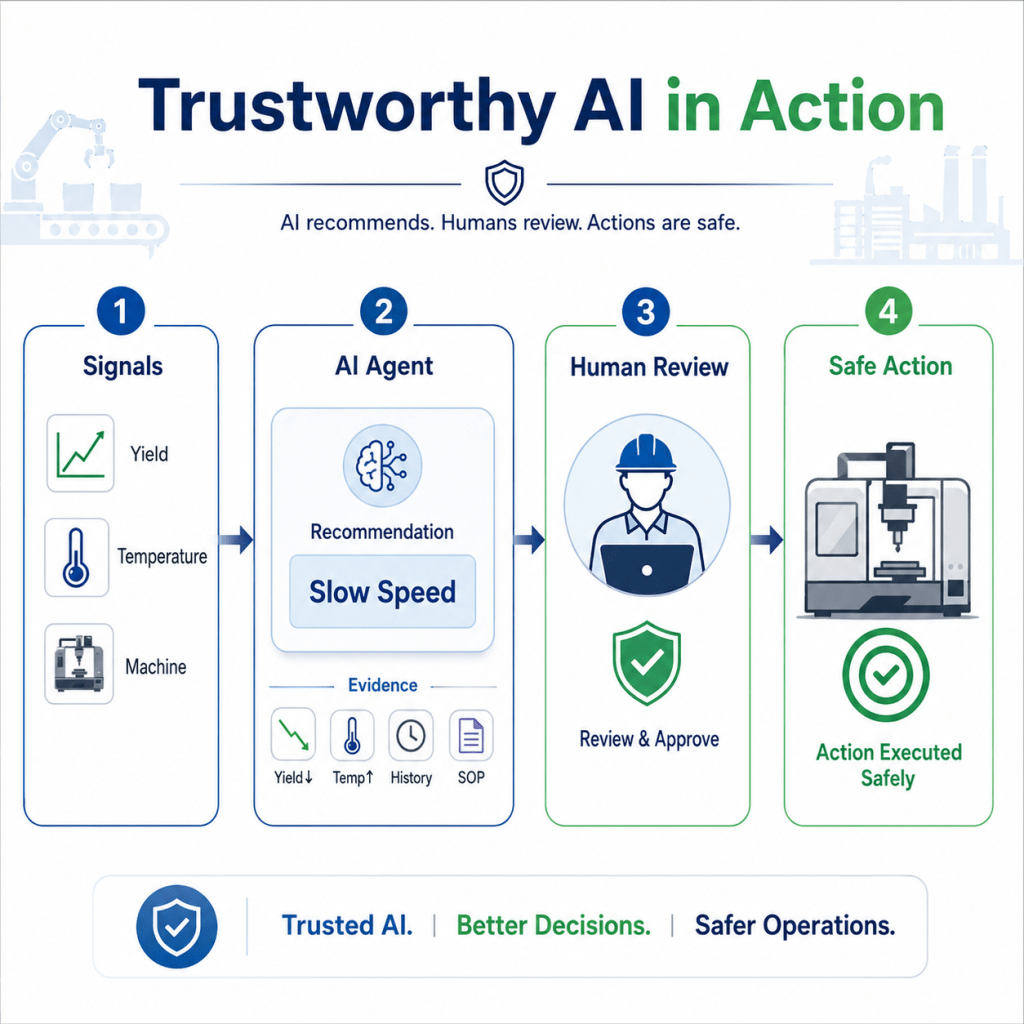
Consider a factory where an AI agent monitors production yield, machine temperature, and quality trends.
The agent detects that yield has started to decline, while machine temperature is slightly higher than normal. It also finds that similar historical cases were linked to process instability.
The AI agent recommends:
“Reduce machine speed temporarily and monitor yield recovery.”
This recommendation may be useful, but it should not be treated as automatically trustworthy.
A trustworthy AI agent should provide supporting information:
- Yield decreased from the expected baseline.
- Machine temperature is above the recent operating range.
- Similar historical cases showed improved stability after conservative speed adjustment.
- The affected product is currently in mass production.
- SOP suggests conservative operation under combined yield and temperature drift.
- The recommended speed adjustment is within the approved operating range.
- Engineer review is required before execution.
This output is much stronger than a simple recommendation.
It gives the human reviewer enough information to understand, evaluate, and approve the action.
The engineer can then decide whether to:
- approve the recommendation,
- request further inspection,
- adjust the recommendation,
- delay the action,
- or reject it due to missing context.
This is what trustworthy AI looks like in manufacturing.
It does not only produce an answer.
It produces an answer that can be explained, checked, reviewed, and traced.
5. From AI Output to Accountable Decision-Making
Many AI projects focus on generating outputs.
However, in manufacturing, the goal should be accountable decision-making.
There is a major difference between these two ideas.
An AI output says:
“This is the recommended action.”
An accountable decision system shows:
“This is the recommended action, based on these data sources, under these conditions, aligned with these rules, reviewed by this person, and recorded for future learning.”
This shift is important.
Manufacturers do not only need AI systems that are smart. They need AI systems that are reliable in daily operations.
A trustworthy AI agent should support four practical needs:
5.1 Understand
Users should understand what the AI agent is recommending and why.
5.2 Review
Users should be able to review the evidence, assumptions, and risk level.
5.3 Control
The organization should define which actions can be automated and which require approval.
5.4 Improve
The system should learn from outcomes, feedback, and reviewed decisions.
This makes AI agents part of a continuous improvement loop.
6. Practical Checklist for Trustworthy AI Agents
Before deploying AI agents in manufacturing, companies can use a simple checklist.
Data and Context
- Does the AI agent know the production line, product, work order, shift, and material batch?
- Does it connect MES, ERP, equipment, quality, and maintenance data?
- Does it compare current signals with historical baselines?
Model and Recommendation
- Is the model accurate enough for the target use case?
- Does the system identify uncertainty or risk level?
- Does the recommendation match the operational problem?
Explanation and Evidence
- Can the agent explain why it made the recommendation?
- Does it show the data, trends, or rules behind the decision?
- Can engineers validate the reasoning?
Rules and Guardrails
- Does the recommendation follow SOPs?
- Are process and safety limits enforced?
- Are approval rules clearly defined?
Human Review and Traceability
- Who reviews medium- or high-risk recommendations?
- Is the final decision recorded?
- Can the decision be audited later?
- Can feedback be used to improve the AI agent?
This checklist helps move AI agents from experimental tools to reliable enterprise systems.
7. Why Trustworthy AI Agents Create Business Value
Trustworthy AI is not only about reducing risk.
It also creates business value.
When users trust AI recommendations, adoption increases. Engineers are more willing to use the system. Managers are more comfortable relying on AI-supported insights. Cross-functional teams can coordinate faster.
A trustworthy AI agent can help manufacturers:
- reduce investigation time,
- improve decision consistency,
- reduce repeated mistakes,
- support faster escalation,
- strengthen quality control,
- improve production stability,
- improve audit readiness,
- and support continuous improvement.
Trust makes AI more usable.
And usability is what turns AI from a pilot project into real operational value.
Conclusion: Trustworthy AI Agents Are Understandable, Reviewable, and Controllable
In manufacturing, an AI agent is not trustworthy simply because it can generate an answer.
It becomes trustworthy when its judgment can be understood, reviewed, traced, and controlled.
Accuracy matters, but it is only the beginning.
A trustworthy AI agent also needs explainability, traceability, guardrails, and human control.
These elements help ensure that AI recommendations are not only technically correct, but also operationally appropriate, auditable, and safe to use.
The goal is not to let AI make every decision alone.
The goal is to help people make better decisions with stronger data, clearer reasoning, and better control.
In smart manufacturing, the most valuable AI agents will be those that combine intelligence with accountability.
They will not only answer questions.
They will help enterprises make decisions they can trust.
 Willie Lin | Smart Manufacturing, Agentic AI & Decision Intelligence
Leave a comment