Business Value of AI Agents in Production Scheduling
Scheduling Is No Longer Just a Planning Task
Production scheduling has always been one of the most difficult tasks in manufacturing.
A schedule is not just a list of work orders. It reflects many business decisions: which order should be produced first, which line should be used, how materials should be allocated, how urgent customer needs should be handled, and how disruptions should be managed.
In a stable environment, a production schedule can be prepared in advance and followed with limited adjustment.
However, real manufacturing environments are rarely stable.
Machines may stop unexpectedly. Materials may arrive late. Yield may fluctuate. Urgent orders may be inserted. Labor availability may change. Customer priorities may shift.
When these changes happen, the value of scheduling is no longer only about creating the original plan. The real value comes from how quickly and intelligently the organization can respond.
This is where AI agents can create significant business value.
AI agents help manufacturers move from static scheduling to dynamic decision support. They connect production data, business priorities, operational constraints, and real-time events to support better scheduling decisions.
In other words, AI agents turn scheduling from an operational task into a decision intelligence capability.
1. Why Scheduling Decisions Are Business Decisions
Production scheduling is often treated as a factory-level activity. However, its impact goes far beyond the shop floor.
A scheduling decision can affect:
Customer delivery performance
Production efficiency
Equipment utilization
Inventory movement
Material readiness
Labor allocation
Quality risk
Cost control
Cross-functional coordination
For example, if a high-priority customer order is delayed, the issue is not only a production problem. It may affect sales, customer service, logistics, supply chain planning, and business reputation.
If a planner moves a work order to another line, the decision may reduce delivery risk but increase changeover time or create material movement challenges.
If a schedule is not updated quickly after equipment downtime, the organization may continue working with an outdated plan, causing further delays and confusion.
This means that production scheduling is not only about arranging jobs. It is about managing trade-offs.
A good scheduling system should help answer questions such as:
Which order should be protected first?
Which line has enough capacity?
Which decision creates the lowest delivery risk?
Which action minimizes production disruption?
Which teams need to be informed?
Which decision best balances cost, speed, quality, and customer priority?
AI agents can support these decisions by continuously analyzing the changing production environment.
2. Why Traditional Scheduling Struggles to Create Continuous Value
Traditional scheduling systems can be useful for planning, but they often struggle when factory conditions change.
Many scheduling systems are built around a relatively fixed plan. They assume that machines are available, materials are ready, labor is sufficient, and quality is stable.
But in real operations, these assumptions often break.
A production line may stop for 30 minutes. A material batch may be delayed. A machine may run slower than expected. A defect pattern may reduce usable output. An urgent customer order may suddenly become the top priority.
When this happens, planners must manually collect information from multiple systems and departments. They may need to check ERP orders, MES status, inventory records, equipment conditions, and delivery commitments before deciding what to do next.
This creates several challenges.
First, response time becomes slow.
Second, decision quality depends heavily on individual experience.
Third, different departments may work with different versions of the situation.
Fourth, schedule changes may not be communicated quickly enough.
Fifth, the organization may react after the problem has already affected delivery or capacity.
AI agents can reduce these weaknesses by helping planners see changes earlier, evaluate options faster, and coordinate decisions more effectively.
3. What AI Agents Add to Production Scheduling
AI agents are valuable because they can connect data, context, reasoning, and action.
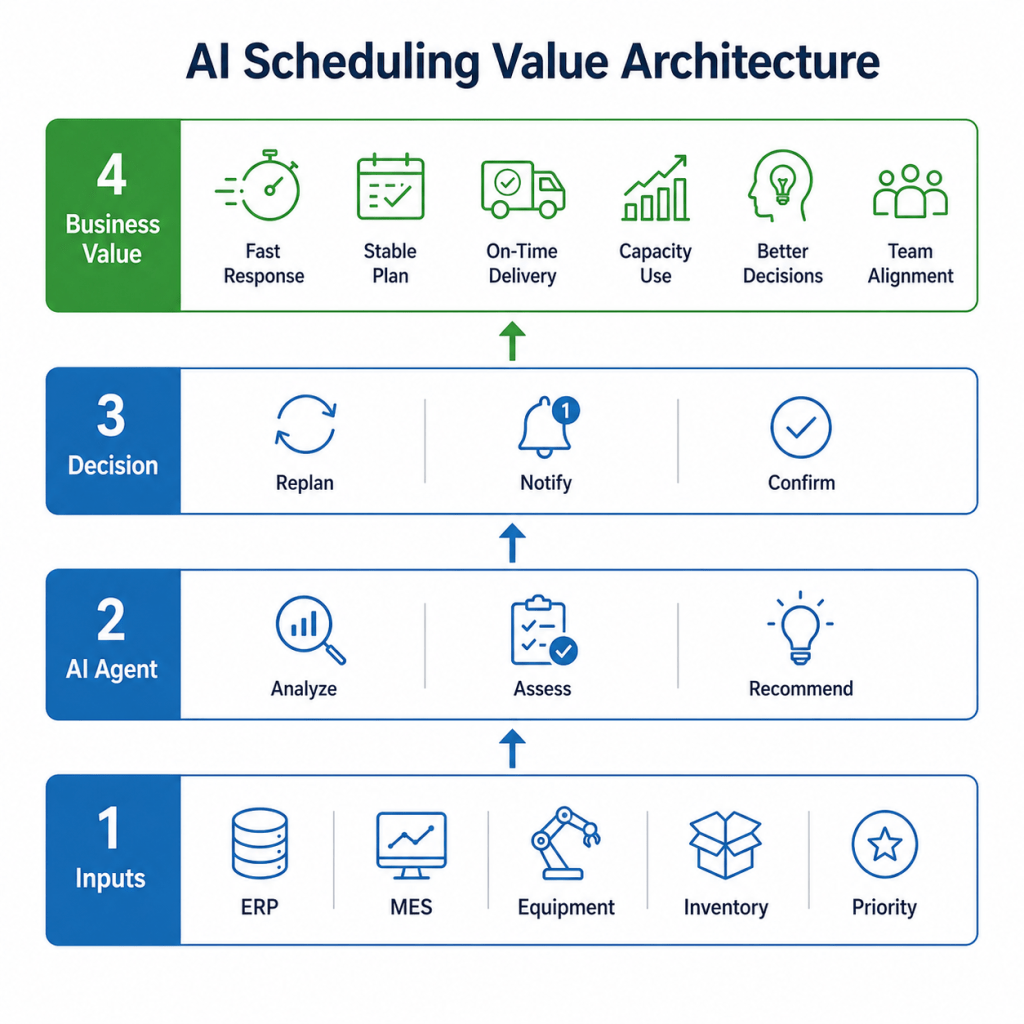
For production scheduling, an AI agent can integrate information from multiple sources, such as:
ERP orders
MES production status
Equipment availability
Inventory levels
Material readiness
Quality and yield signals
Delivery priorities
Maintenance events
Labor or line capacity
The agent does not simply display this information. It interprets how these factors affect scheduling decisions.
For example, if a machine stops, the AI agent can identify which work orders are affected, which customer deliveries are at risk, which lines can take over the workload, and whether rescheduling is necessary.
If material is delayed, the agent can suggest alternative work orders that can be produced with available inventory.
If yield drops, the agent can estimate whether the planned output is still achievable and whether extra capacity is needed.
This makes the AI agent a decision-support layer for dynamic scheduling.
It helps the organization move from asking:
What was the original schedule?
to asking:
What should we do now, based on the current situation?
4. Key Business Value of AI Agents in Scheduling
AI agents for production scheduling can create value in several important ways.
4.1 Better Responsiveness
The first business value is better responsiveness.
Manufacturing disruptions are often time-sensitive. The longer the organization takes to respond, the greater the impact may become.
For example, a machine downtime event may seem minor at first. But if the affected order is urgent or the line has no buffer, even a short disruption can create delivery risk.
An AI scheduling agent can detect changes quickly and evaluate their impact immediately.
It can help answer:
Which orders are affected?
How much capacity is lost?
Is the delay recoverable?
Is another line available?
Should the planner be notified?
Should the schedule be updated?
This allows the factory to respond earlier, before the issue becomes more serious.
Better responsiveness does not only mean faster reaction. It means faster understanding.
AI agents help teams understand the meaning of a disruption and what should be done next.
4.2 Higher Schedule Stability
The second business value is higher schedule stability.
A schedule is stable when it can absorb disruptions without causing excessive replanning, confusion, or operational waste.
In many factories, schedule changes can create ripple effects. Moving one order may affect material picking, warehouse preparation, line setup, operator assignment, downstream process flow, and shipment timing.
AI agents can help reduce unnecessary schedule changes by evaluating the impact before recommending action.
For example, when a disruption occurs, the agent can compare different options:
Keep the order on the same line and recover later
Move part of the order to another line
Delay a low-priority order
Split the workload across two lines
Notify supply chain about possible delay
Request overtime or maintenance escalation
The best decision is not always the fastest change.
Sometimes the best decision is to maintain the current schedule and monitor the risk. Sometimes it is better to reassign work early.
AI agents help identify which option creates the least disruption while still protecting delivery and capacity.
This improves schedule stability.
4.3 Improved Delivery Performance
The third business value is improved delivery performance.
Customer delivery is one of the most important business outcomes affected by production scheduling.
A delay often starts as a small operational issue: a machine stops, a material is late, or yield is lower than expected. If the issue is not detected and managed early, it may become a customer delivery problem.
AI agents can help protect delivery commitments by identifying risks earlier.
For example, the agent can compare:
Current production progress
Remaining capacity
Order due dates
Customer priority
Material readiness
Alternative line availability
Expected recovery time
Based on this analysis, the agent can highlight which orders are at risk and recommend corrective actions.
This helps planners focus on orders that matter most.
Instead of treating all delays equally, the AI agent can support priority-based decision-making.
This is important because not every delay has the same business impact.
A delay in a high-priority customer order may require immediate action, while a lower-priority order may be safely rescheduled.
AI agents help manufacturers protect delivery performance by connecting shop-floor events with business priorities.
4.4 Better Use of Capacity
The fourth business value is better capacity utilization.
Production capacity is often limited. Machines, lines, labor, and materials must be allocated carefully.
When scheduling is managed manually, available capacity may not be fully visible. One line may be overloaded while another line has available time. A planner may not immediately know whether an alternative line can take over a job.
AI agents can help by continuously checking capacity across lines and resources.
They can support decisions such as:
Which line can produce this order?
Is the alternative line compatible with this product?
How much setup time is required?
Will moving the order create another bottleneck?
Can the order be split across lines?
Is there enough material for the new assignment?
This helps the factory use available capacity more effectively.
Better capacity use does not always mean maximizing machine utilization. It means using capacity in a way that supports business goals, delivery commitments, quality requirements, and operational stability.
AI agents can help balance these objectives.
4.5 Stronger Decision Quality
The fifth business value is stronger decision quality.
Scheduling decisions are complex because they involve multiple factors at the same time.
A planner may need to consider:
Delivery priority
Equipment availability
Material readiness
Changeover cost
Yield risk
Labor constraints
Customer importance
Inventory impact
Maintenance timing
Downstream process capacity
Without AI support, it is difficult to evaluate all of these factors quickly and consistently.
AI agents can help structure the decision.
They can collect relevant data, compare options, estimate risks, and explain the trade-offs.
For example, the agent may recommend:
“Move urgent Order A to Line 3. Line 3 has available capacity and compatible setup. Delay Order B by two hours because it has lower delivery priority. Notify the planner and warehouse team because material movement is required.”
This type of recommendation is useful because it combines data, context, and business logic.
It does not only suggest an action. It explains why the action makes sense.
This improves decision quality and makes scheduling decisions easier to review.
4.6 Improved Cross-Functional Communication
The sixth business value is improved cross-functional communication.
Production scheduling affects many teams.
When a schedule changes, the impact may involve:
Production control
Shop-floor supervisors
Warehouse teams
Procurement
Maintenance
Quality engineers
Supply chain planners
Sales or customer service
If these teams are not informed at the right time, the schedule change may create confusion.
For example, production may update the schedule, but the warehouse may still prepare materials for the old plan. Or sales may not know that a delivery risk has appeared. Or maintenance may not know that a machine issue is affecting a high-priority order.
AI agents can help by notifying the right teams based on the type of change.
For example:
If material is delayed, notify procurement and planning.
If a machine fails, notify maintenance and production control.
If delivery is at risk, notify supply chain and customer-facing teams.
If quality risk appears, notify process and quality engineers.
If a work order is reassigned, notify warehouse and line supervisors.
This turns scheduling into a connected workflow.
The AI agent becomes a coordination layer that helps different functions work with the same information.
5. A Simple Manufacturing Example
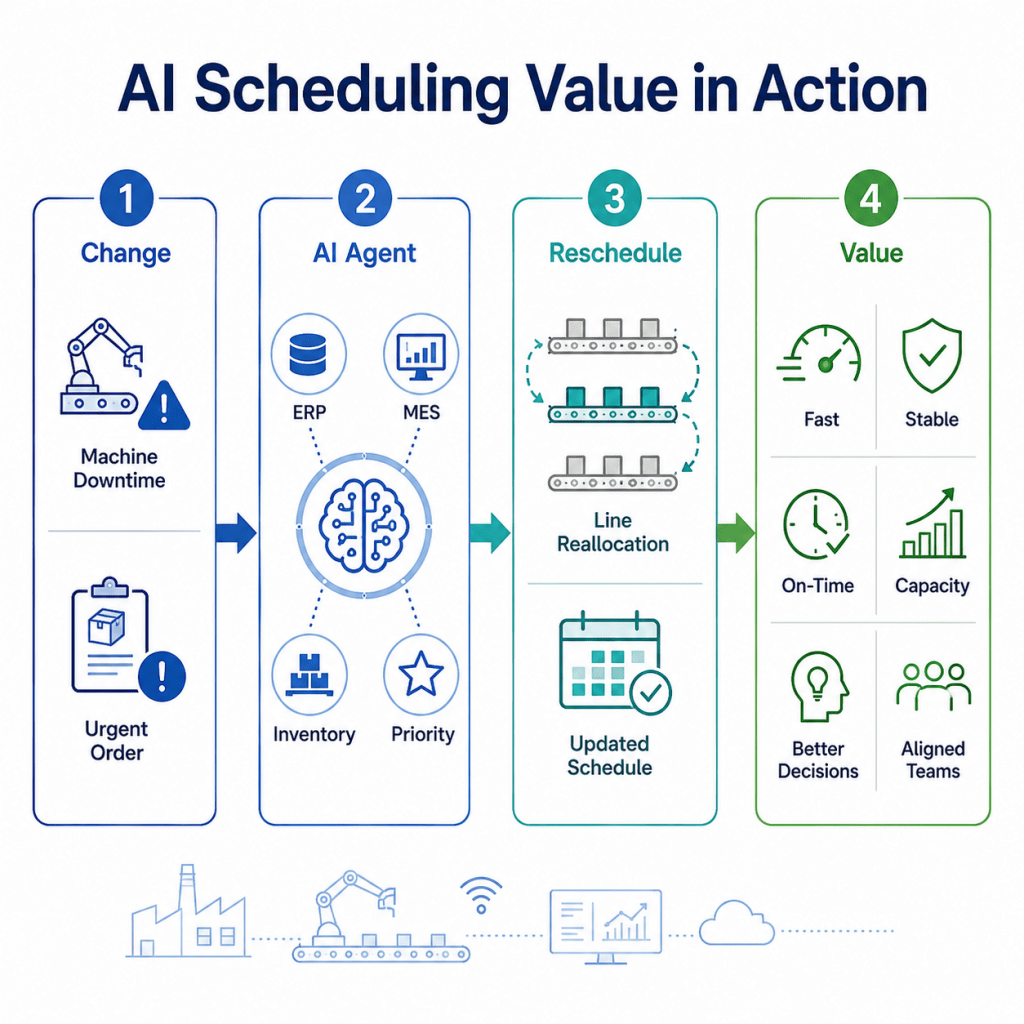
Consider a factory with four production lines.
Line 2 suddenly stops for 30 minutes due to equipment trouble.
In a traditional process, the planner may need to manually check the affected work orders, available capacity, material status, and delivery deadlines. This may take time, and the decision may depend heavily on the planner’s experience.
With an AI scheduling agent, the response can be more structured.
The agent detects the downtime and checks:
Which work orders are assigned to Line 2
Whether the affected orders are urgent
Whether other lines can produce the same product
Whether materials are available near the alternative line
Whether moving the order will require a major changeover
Whether delivery commitments are at risk
Which teams need to be informed
After analysis, the agent may recommend:
Move the urgent order to Line 3
Keep the non-urgent order on Line 2 after recovery
Delay a lower-priority order by two hours
Notify the planner, warehouse, and maintenance team
Monitor delivery risk until the schedule stabilizes
This recommendation creates value in several ways.
The factory responds faster. The schedule becomes more stable. Delivery risk is reduced. Capacity is used more effectively. The planner makes a better decision. The right teams receive the right information.
This example shows how AI agents create business value beyond simple scheduling optimization.
They help the organization coordinate decisions under changing conditions.
6. From Scheduling Optimization to Decision Intelligence
Many companies think of scheduling improvement as an optimization problem.
Optimization is important, but it is not enough.
A scheduling system may generate a mathematically efficient plan, but if it cannot respond to real-time disruptions, it may not create enough business value.
Manufacturing scheduling should be viewed as part of decision intelligence.
Decision intelligence means using data, models, rules, context, and human judgment to improve decision-making.
In production scheduling, this means connecting:
data from ERP, MES, equipment, and inventory,
operational constraints from the factory,
business priorities from customers and delivery commitments,
AI reasoning for analysis and recommendation,
and human review for high-impact decisions.
AI agents support this by acting as a bridge between data and action.
They help transform scheduling from a fixed plan into a dynamic decision system.
7. How to Start Building AI Agent Value in Scheduling
Companies do not need to build a fully autonomous scheduling agent from the beginning.
A practical approach is to start small and expand gradually.
Stage 1: Visibility
Start by using AI agents to summarize scheduling risks.
The agent can highlight:
delayed orders,
overloaded lines,
material shortages,
equipment downtime,
and delivery risks.
At this stage, the agent helps planners see problems earlier.
Stage 2: Recommendation
Next, the agent can recommend possible scheduling actions.
For example:
move an order,
delay a lower-priority job,
split production,
check material readiness,
or notify another team.
At this stage, the agent helps planners evaluate options.
Stage 3: Human-Confirmed Execution
For medium-impact decisions, the AI agent can recommend actions that require planner confirmation before execution.
At this stage, the agent supports controlled automation.
Stage 4: Closed-Loop Learning
Finally, the system can record decisions and outcomes.
It can learn which recommendations worked, which were rejected, and which rules need to be adjusted.
At this stage, scheduling becomes a continuous learning system.
This gradual roadmap helps companies build trust and business value step by step.
8. Practical Success Factors
To create real value from AI agents in scheduling, companies should pay attention to several success factors.
8.1 Data Integration
The AI agent needs access to reliable ERP, MES, equipment, inventory, and delivery data.
Without integrated data, the agent cannot understand the full scheduling situation.
8.2 Context Awareness
The agent must understand production context, including product type, line capability, changeover requirements, material readiness, and customer priority.
Context is what turns data into useful scheduling intelligence.
8.3 Clear Decision Rules
The organization should define which actions can be recommended, which require approval, and which should not be automated.
This prevents uncontrolled decision-making.
8.4 Human Review
Planners and managers should remain involved in medium- and high-impact scheduling decisions.
AI should support human judgment, not replace it completely.
8.5 Feedback and Learning
Every recommendation, decision, and outcome should be recorded.
This allows the AI agent to improve over time.
Conclusion: AI Agents Turn Scheduling into Business Decision Intelligence
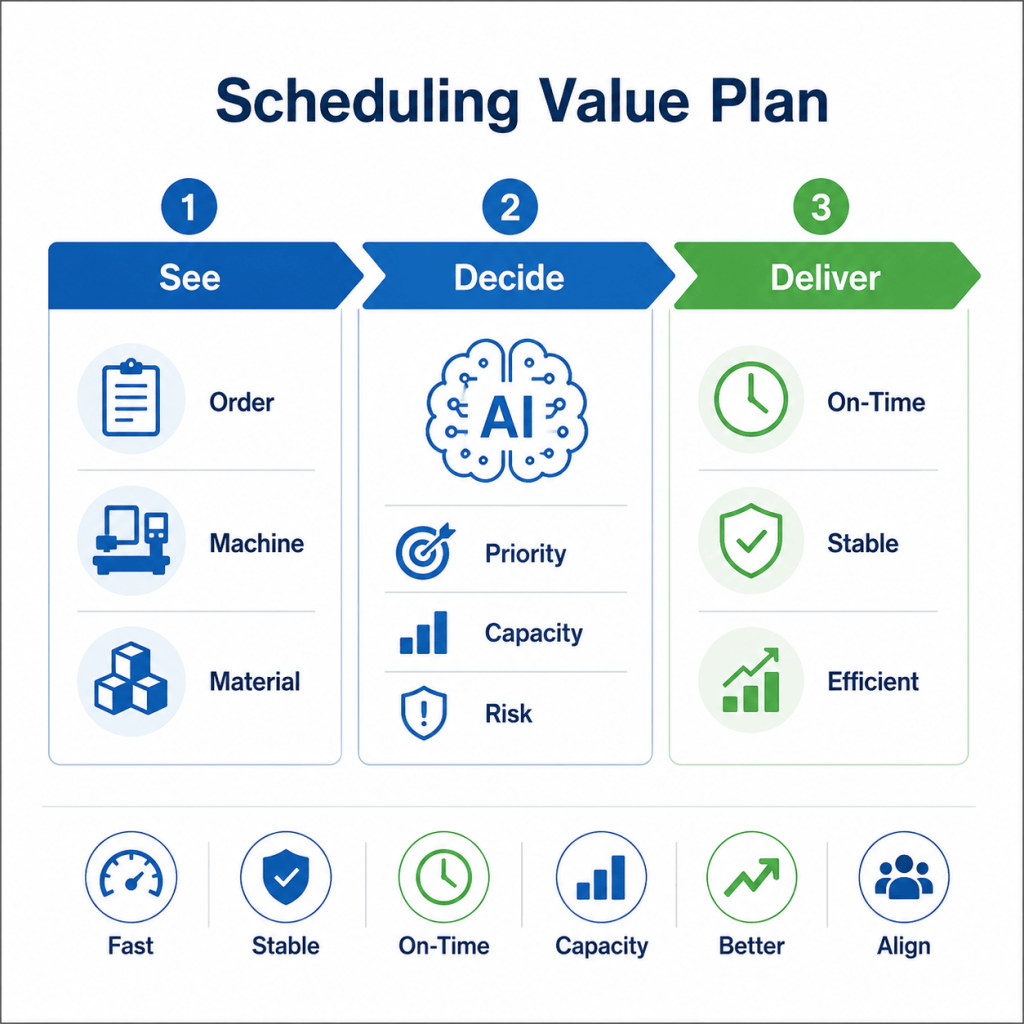
AI agents create business value in production scheduling because they help manufacturers respond faster, stabilize plans, protect delivery, use capacity better, improve decision quality, and strengthen cross-functional communication.
This makes scheduling more than an operational task.
It becomes part of a broader decision intelligence capability.
Traditional scheduling focuses on creating a plan.
AI-enabled scheduling focuses on continuously improving decisions when conditions change.
This shift is important because real manufacturing is dynamic. Equipment may fail, materials may be delayed, urgent orders may appear, and production performance may change.
AI agents help manufacturers manage this complexity by connecting data, context, reasoning, and action.
The result is not just a better schedule.
The result is a more responsive, resilient, and intelligent manufacturing operation.
 Willie Lin | Smart Manufacturing, Agentic AI & Decision Intelligence
Leave a comment