For many people, NVIDIA is still mainly understood as a GPU company.
That view is no longer enough.
NVIDIA is increasingly positioning itself as an infrastructure and platform company for the next stage of artificial intelligence: AI factories, physical AI, robotics, digital twins, and agentic workflows. In manufacturing, this shift matters because factories do not only need better models. They need systems that can observe operations, understand context, simulate changes, recommend actions, and eventually support safer, faster industrial decisions.
This is where the idea of the agentic AI factory becomes important.
An agentic AI factory is not just a data center running large models. It is a decision and operations platform that can connect computing infrastructure, industrial data, simulation environments, vision systems, robotics, and AI agents into one industrial intelligence loop.
Why NVIDIA Matters in Agentic AI
NVIDIA’s role in agentic AI starts with infrastructure.
Modern AI agents require high-performance computing to train models, run inference, process multimodal data, simulate environments, and support real-time decision workflows. NVIDIA describes AI factories as a new class of infrastructure that “manufacture intelligence” for reasoning models, agents, and intelligent systems. In this view, tokens become a new unit of production for AI-driven systems.
This is an important shift.
Traditional factories convert materials into products. AI factories convert data, models, and compute into intelligence. For manufacturing companies, that intelligence may appear as quality inspection recommendations, maintenance risk alerts, production scheduling suggestions, digital twin simulations, or robot task planning.
In other words, NVIDIA is not only selling GPUs. It is helping define the infrastructure layer for industrial intelligence.
From GPU Acceleration to AI Factory Platform
The first layer of NVIDIA’s agentic AI story is accelerated computing.
GPUs, networking, AI servers, and software libraries provide the compute foundation for training and deploying AI systems. But for manufacturing, compute alone is not the full story. Industrial companies need AI systems that understand physical environments, operational constraints, and real-time production conditions.
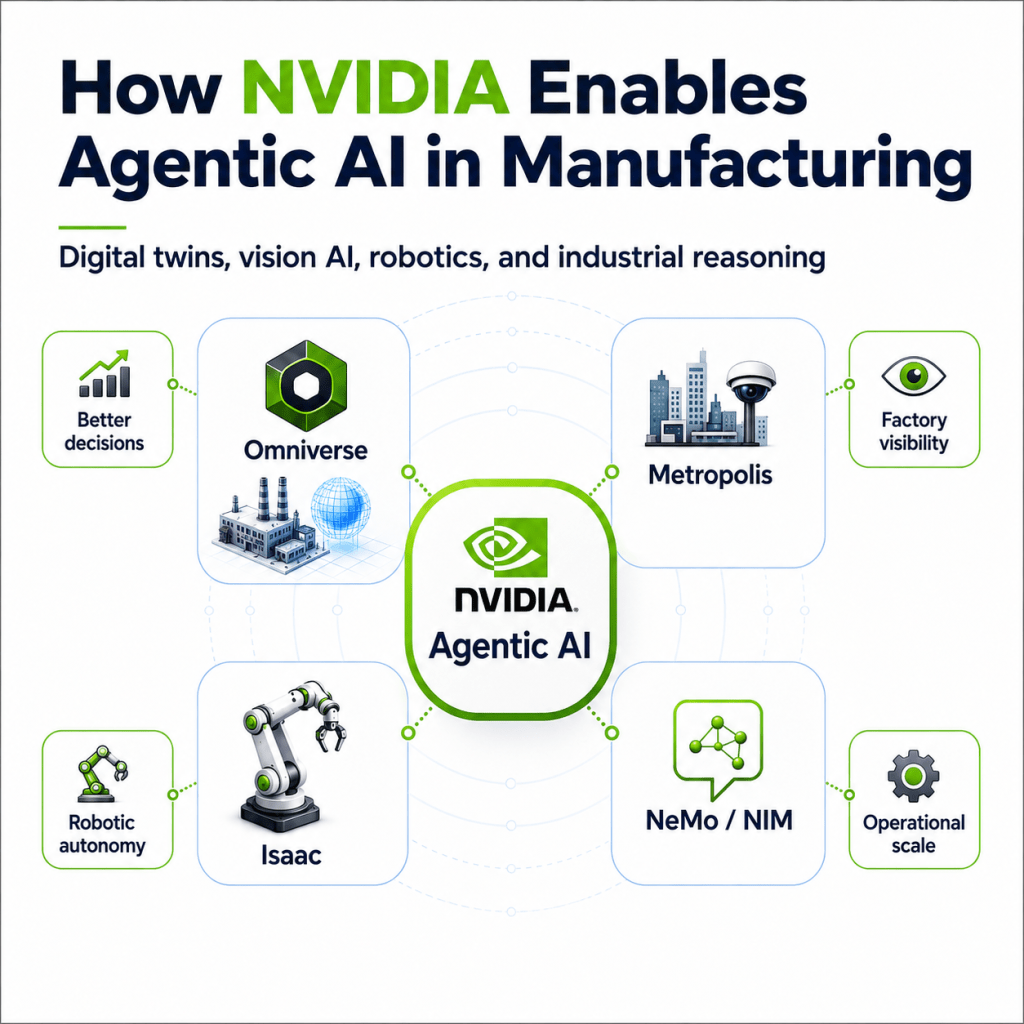
That is why NVIDIA’s platform strategy extends into multiple industrial domains:
Omniverse for digital twins and simulation.
Isaac for robotics development and simulation.
Metropolis for visual AI applications and visual AI agents.
NeMo and NIM for model services, inference, and enterprise AI deployment.
Cosmos for physical AI and world foundation models.
NVIDIA describes Omniverse as a collection of libraries and microservices for developing physical AI applications such as industrial digital twins and robotics simulation. Metropolis is described as a platform and partner ecosystem for developing, deploying, and scaling visual AI agents from edge to cloud.
This combination matters because manufacturing is physical, not purely digital.
A factory AI agent cannot only read text. It may need to interpret video, monitor machine states, understand layout constraints, simulate robot movements, and compare production options before recommending an action.
Why Manufacturing Is a Natural Fit
Manufacturing operations are full of dynamic constraints.
Machines break down. Materials arrive late. Product mix changes. Quality issues emerge. Operators need instructions. Robots need safe paths. Engineers need to test changes before deployment.
This is exactly the kind of environment where agentic AI becomes useful.
At Hannover Messe 2026, NVIDIA and its partners presented manufacturing scenarios involving accelerated computing, AI physics, agents, robotics, agentic design and engineering, real-time simulation, vision AI agents, and humanoid robots in factories.
The message is clear: NVIDIA wants to support the full industrial AI lifecycle, from design to simulation to perception to action.
The Agentic AI Factory Loop
A practical agentic AI factory can be understood as a loop:
Design → Simulation → Perception → Reasoning → Action → Feedback
In this loop, digital twins help engineers model and test systems before physical deployment. Vision AI observes what is happening in the factory. Robotics systems act in the physical environment. AI agents reason over data, detect risks, recommend actions, and coordinate workflows. Human reviewers provide governance for high-impact decisions.
This loop is what makes agentic AI different from traditional automation.
Traditional automation follows fixed rules. Agentic AI systems can use context, tools, and reasoning to support more flexible decisions. In manufacturing, that could mean detecting a quality issue, checking related process conditions, reviewing similar past events, recommending containment actions, and routing the case for human approval.
NVIDIA’s Advantage: Connecting the Digital and Physical Worlds
The strongest part of NVIDIA’s industrial AI position is not only model performance. It is the connection between digital and physical systems.
Omniverse supports digital twin and simulation workflows. Isaac supports robotics development. Metropolis supports visual AI and camera-based intelligence. NeMo and NIM support AI model deployment and services. Together, these capabilities create a platform that can support industrial AI agents across both software and physical operations.
This is especially important in smart manufacturing, where data is fragmented across MES, ERP, quality systems, maintenance systems, cameras, sensors, robots, and engineering tools.
An AI agent becomes more valuable when it can connect these sources into a meaningful operational workflow.
Example: From Quality Alert to Factory Action
Imagine a production line where a vision AI system detects a defect pattern.
A traditional system might simply flag the defect. An agentic AI workflow could go further.
It could compare recent defect images, retrieve process parameters, check whether a specific material lot is involved, search historical quality cases, estimate whether the issue is spreading, recommend a containment action, and create a review task for quality engineering.
If connected to a digital twin, the system could also simulate whether a process adjustment might reduce the defect risk before the change is made on the real line.
This is the practical value of an agentic AI factory: not only detecting problems, but helping people decide what to do next.
What Manufacturers Can Learn from NVIDIA
The lesson for manufacturers is not that every company must build a massive AI factory immediately.
The lesson is that AI capability is becoming a stack.
Manufacturers need data infrastructure, model services, simulation environments, perception systems, robotics integration, workflow orchestration, and human governance. Agentic AI is useful only when these pieces connect to real decisions.
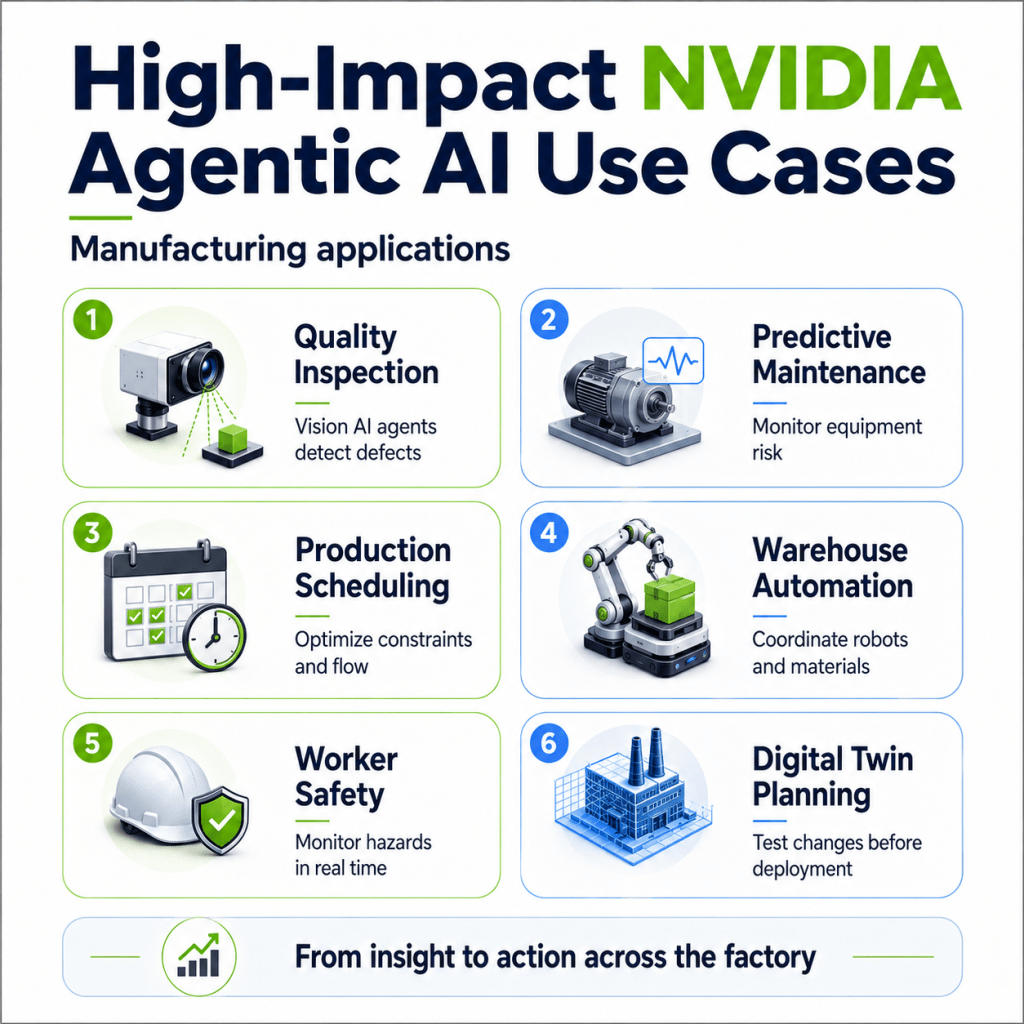
A good starting point is not “build a general AI system.” A better starting point is one high-value workflow:
Quality inspection follow-up.
Predictive maintenance prioritization.
Production scheduling recovery.
Warehouse automation.
Worker safety monitoring.
Digital twin planning.
Start with one workflow. Connect the required data. Add reasoning. Add human review. Measure the business result.
Risks and Limitations
NVIDIA’s agentic AI factory vision is powerful, but manufacturers should not treat it as a plug-and-play solution.
Several challenges remain.
First, industrial data is often fragmented and inconsistent. Second, factory workflows involve safety, quality, compliance, and operational risk. Third, AI agents require careful governance, especially when recommendations affect production or people. Fourth, simulation and digital twins require high-quality models of real systems.
In manufacturing, trust is not created by impressive demos. Trust is created by reliable data, clear explanations, controlled actions, and measurable outcomes.
Conclusion
NVIDIA’s evolution from GPU company to agentic AI factory platform reflects a larger shift in industrial AI.
The future of smart manufacturing is not only about better dashboards or faster models. It is about connecting accelerated computing, digital twins, vision AI, robotics, model services, and AI agents into decision workflows.
For manufacturers, the question is no longer whether AI can analyze data.
The more important question is:
Can AI help the factory decide and act better?
That is where NVIDIA’s agentic AI factory story becomes strategically important.
 Willie Lin | Smart Manufacturing, Agentic AI & Decision Intelligence
Leave a comment