A manufacturing AI agent is a goal-driven system that helps factories turn operational data into decisions and actions.
Most factories already have data. They have production dashboards, ERP reports, MES transactions, quality records, maintenance alerts, spreadsheets, and daily meeting notes. However, data alone does not solve operational problems. Someone still needs to interpret the situation, understand constraints, compare options, coordinate with other teams, and decide what to do next.
A manufacturing AI agent helps close this gap.
Instead of only answering questions, an AI agent can analyze context, reason through trade-offs, recommend actions, use digital tools, and involve humans when approval is required.
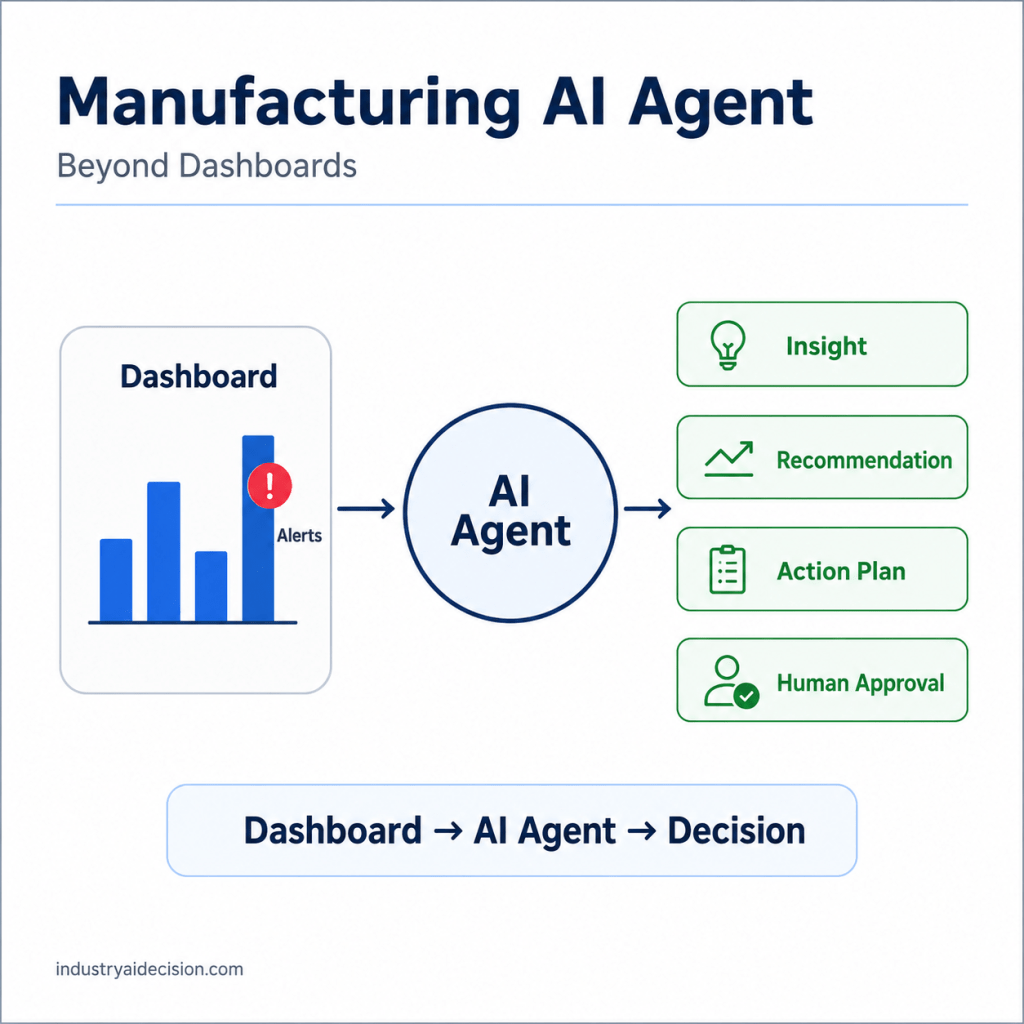
From Dashboard to Decision
A dashboard tells you what is happening.
For example, it may show that production output is below target, machine downtime increased, or a customer order is at risk of being late.
But a dashboard usually does not explain what action should be taken. It does not automatically compare material availability, machine capacity, quality constraints, and delivery priorities. It does not prepare a recommended recovery plan.
A manufacturing AI agent can help move from visibility to decision-making.
For example, if a production line falls behind schedule, the agent can check the open work orders, machine status, current WIP, available labor, material constraints, and customer due dates. Then it can recommend whether to resequence jobs, move work to another line, request overtime, or escalate a material shortage.
This is why AI agents are especially relevant for smart manufacturing. They help connect information across systems and support decisions across departments.
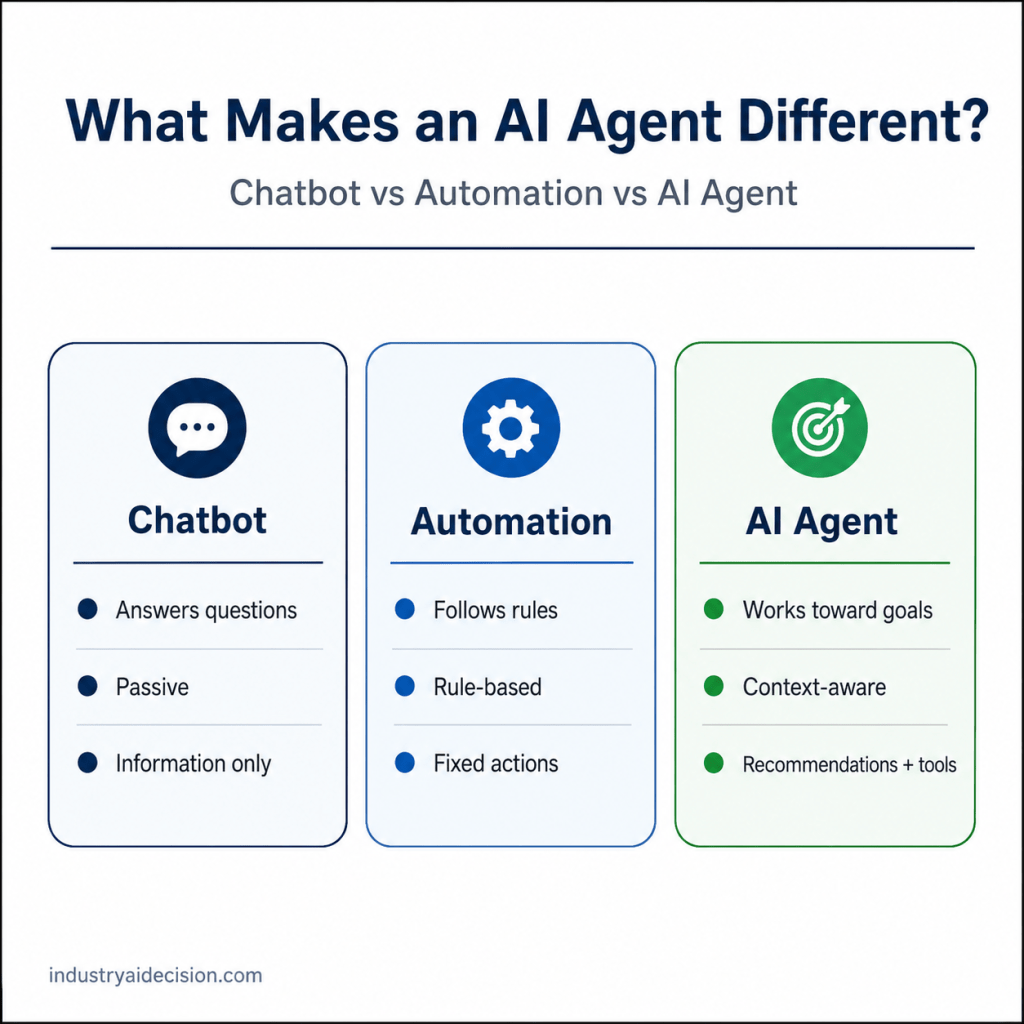
AI Agent vs Chatbot vs Automation
A chatbot answers user questions.
A workflow automation system follows predefined rules.
A manufacturing AI agent is different because it works toward a goal and can handle more dynamic situations.
For example, a chatbot may answer: “What is the status of order 12345?”
A rule-based automation may send an alert when inventory drops below a threshold.
An AI agent may analyze whether order 12345 is at risk, identify the cause, check alternative production options, estimate the impact, and recommend a recovery plan.
This does not mean the agent should make every decision by itself. In manufacturing, many actions require human review. The best AI agents combine intelligent recommendations with controlled execution.
What a Manufacturing AI Agent Needs
A useful manufacturing AI agent needs four things.
First, it needs data context. This may include production schedules, equipment status, work orders, quality data, inventory, supplier information, maintenance history, and SOPs.
Second, it needs a reasoning process. The agent must be able to compare options, identify constraints, and explain why one action is better than another.
Third, it needs tool access. The agent may need to query a database, retrieve a document, create a ticket, draft a report, or update a workflow.
Fourth, it needs governance. Manufacturing decisions can affect safety, quality, delivery, and cost. High-impact actions should require approval, audit logs, and clear accountability.
Example: Late Order Recovery
Imagine a customer order is at risk of being late.
A traditional system may show the order status. A planner then needs to manually check whether material is available, whether a machine has capacity, whether another job can be delayed, and whether shipping can be expedited.
A manufacturing AI agent can support the planner by analyzing the situation automatically.
It may identify that the delay is caused by a bottleneck machine. It may check whether a second machine can run the same product. It may evaluate the changeover time, open capacity, and delivery impact. It may recommend moving the job to another line and explain the trade-off.
The planner still makes the final decision, but the decision is faster, better informed, and easier to communicate.
Where Manufacturing AI Agents Create Value
Manufacturing AI agents are most valuable when the workflow is repetitive but not fully predictable.
Good examples include production scheduling, yield loss analysis, quality issue follow-up, predictive maintenance, material shortage management, root cause analysis, and daily production meeting preparation.
These workflows require data from multiple sources. They also require judgment. That combination makes them ideal candidates for AI agents.
Conclusion
A manufacturing AI agent is not just a smarter chatbot. It is a decision-support system that can understand factory context, reason through options, interact with tools, and support human approval.
For manufacturers, the opportunity is clear. The next stage of smart manufacturing is not only about collecting more data. It is about helping teams make better decisions faster.
 Willie Lin | Smart Manufacturing, Agentic AI & Decision Intelligence
Leave a comment