
Semiconductor equipment conversion yield is becoming a board-level operating metric. SEMI’s latest data show record equipment billings, but an invoiced tool is not yet productive capacity. It must arrive at a ready site, be installed and integrated, qualify its process, stabilize yield and throughput, and sustain output. The editorial thesis is that chipmakers and equipment suppliers should govern this conversion path as deliberately as capital spending: record billings measure industrial commitment, while conversion yield measures whether commitment becomes qualified wafers on schedule.
What changed: equipment billings reached a second record quarter
On 3 September 2026, SEMI reported global semiconductor equipment billings of $40.53 billion for the second quarter, up 23 percent year over year and 11 percent from the prior quarter. SEMI called it a second consecutive record quarter and attributed momentum to advanced manufacturing capacity for AI infrastructure. The association said its Worldwide Semiconductor Equipment Market Statistics compile member data from SEMI and the Semiconductor Equipment Association of Japan. These are industry-reported billings, not a direct measure of installed or qualified fab output. (SEMI, 3 Sep 2026)
SEAJ’s public statistics page dated its worldwide semiconductor manufacturing equipment report 4 September and its latest three-month-average Japanese equipment sales report 21 August. SEMI’s July forecast separately projected OEM equipment sales of $165.9 billion in 2026, up 23.2 percent, and $229.5 billion in 2028. That forecast is not a guaranteed outcome. Together, the releases indicate unusually strong capital intensity across leading-edge logic, advanced memory, test, and packaging—and make execution after purchase more consequential. (SEAJ, 4 Sep 2026; SEMI forecast, 14 Jul 2026)
For infrastructure synchronization, see our grid-ready fab investment framework.
Supplier disclosures reinforce the capacity race. ASML reported second-quarter net sales of €9.3 billion and said customer expansion plans were accelerating; it planned to add 30 percent to 2026 low-NA EUV capacity of about 65 systems for 2027 and a similar increase to DUV immersion capacity of about 130. Applied Materials said customers had found ways around cleanroom-space constraints, were providing rolling eight-quarter forecasts, and were demanding faster tool deliveries, field support, yield improvement, and output optimization. These are supplier-attributed plans and observations. (ASML Q2 results, 15 Jul 2026; Applied Materials Q3 prepared remarks, 13 Aug 2026)
Why semiconductor equipment conversion yield matters now
Why does semiconductor equipment conversion yield matter now? AI demand is pulling investment toward process steps with long qualification cycles and tight dependencies: leading-edge logic, DRAM, HBM, advanced packaging, and metrology. The scarce resource is no longer only the machine. It is the synchronized system around the machine—utilities, cleanroom, technicians, spares, recipes, test material, metrology, automation interfaces, process windows, maintenance capacity, and customer qualification. A delay at any link can turn capital delivery into idle depreciation.
Five gates from delivery to qualified capacity
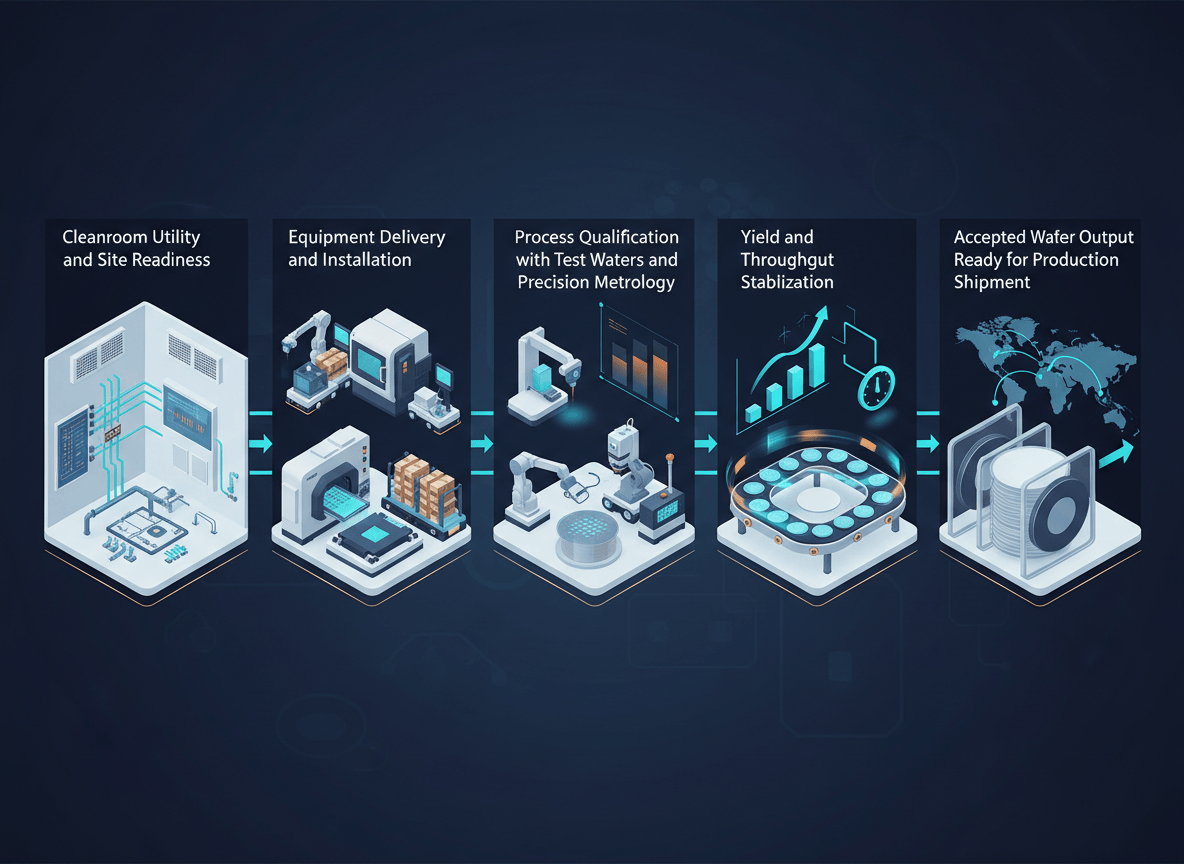
A useful operating model has five gates. Gate one is site and utility readiness. Gate two is delivery, installation, and systems integration. Gate three is process qualification against documented specifications. Gate four is yield and throughput stabilization. Gate five is productive-capacity acceptance, where output is reliable enough to support customer and financial commitments. Each gate should have entry evidence, acceptance criteria, accountable owners, planned and actual dates, unresolved risks, and a rule for escalating cross-company constraints.
Site readiness starts before the tool ships. Facilities teams must verify floor loading, vibration, temperature, humidity, exhaust, vacuum, gases, chemicals, ultra-pure water, power quality, network segmentation, material flow, and safety controls. They also need trained staff, approved work packages, rigging access, spares, and waste capacity. My interpretation is that a ‘ready cleanroom’ should be a signed evidence package, not a forecast status. Suppliers should not be asked to absorb uncertainty created by missing utilities or changing layouts.
The installation gate turns a delivered asset into an integrated system. It includes receipt inspection, move-in, assembly, calibration, software and firmware baselines, interface tests, safety interlocks, factory and site acceptance evidence, and connection to manufacturing execution and equipment-control systems. Schedule risk often concentrates at interfaces: facility contractors, OEM engineers, automation teams, process owners, and cybersecurity reviewers may each optimize a separate plan. One integrated installation owner should manage the critical path and daily constraints.
Process qualification asks whether the tool can repeatedly perform the intended step inside the required process window. Test wafers, recipes, metrology, matching to reference tools, defect performance, run-to-run control, and traceable data all matter. A tool may meet vendor specifications yet still fail the fab’s product-specific requirement. Leaders should distinguish supplier acceptance, process qualification, and customer product qualification; collapsing them into a single ‘installed’ milestone hides risk and gives finance an overly optimistic view of capacity.
Yield and throughput stabilization converts technical capability into an operating asset. The fab must demonstrate repeatable cycle time, availability, recipe performance, defectivity, maintenance recovery, matching, and output under representative product mix. Applied Materials said more than 37,000 chambers were connected to its AIx capabilities and described monitoring, diagnostics, and predictive analytics as tools for yield and service growth. This is a vendor claim, but it illustrates the growing value of installed-base data after the initial sale. (Applied Materials Q3 prepared remarks, 13 Aug 2026)
For learning velocity, see our semiconductor discovery-to-production loop.
Productive-capacity acceptance should connect engineering evidence to the business plan. The gate is passed when the tool or module sustains qualified output at an agreed rate, with stable maintenance burden and a known constraint profile. TSMC reported that advanced technologies accounted for 77 percent of second-quarter wafer revenue and expected a steep 2-nanometer ramp in the third quarter. That company result does not reveal tool-level conversion, but it shows why schedule and yield conversion at advanced nodes can quickly affect revenue mix and customer supply. (TSMC Q2 results, 16 Jul 2026)
Imagine a fab receiving a cluster of deposition, etch, lithography, and metrology tools for an advanced-memory ramp. Delivery may be on time while one gas system, automation interface, or matching study is late. Local dashboards can all appear green because each team reports its own scope. A conversion-yield view instead tracks the cluster through common gates and measures how much planned productive output has been accepted by the required date. The bottleneck becomes visible before customer qualification slips.
My perspective and four implications
In my view, the first implication is that capital efficiency should be measured with time-to-qualified-output, not only purchase-price variance and installation completion. A lower tool price can be economically inferior if integration, qualification, or service delays defer output. Boards should ask for the age distribution of delivered-but-unqualified equipment, the value of capital in each gate, and the reasons for missed acceptance dates. Those measures expose conversion losses without pretending that every tool has the same complexity.
The second implication is that the bottleneck may move from factory manufacturing to field execution. ASML and Applied are expanding system capacity, manufacturing space, service capability, and customer support in response to demand. As more tools arrive, experienced installation engineers, process experts, metrology capacity, and parts logistics can become the rate limiter. My judgment is that suppliers and customers should use shared demand horizons to reserve field capacity and training, while avoiding rigid forecasts that create inventory or staffing whiplash. (ASML Q2 results, 15 Jul 2026; Applied Materials Q3 prepared remarks, 13 Aug 2026)
The third implication is contractual. Purchase agreements often emphasize shipment, acceptance, warranty, and performance specifications. A conversion-yield model adds milestone evidence, interface responsibilities, readiness obligations, data access, joint problem-solving, spares, escalation, and remedies aligned to productive output. The objective is not to transfer every delay to the supplier. It is to prevent ambiguous ownership at the boundaries where facilities, software, process, and product qualification meet.
The fourth implication concerns portfolio sequencing. When multiple fabs and product lines compete for tools and experts, leaders should allocate scarce conversion capacity to the highest system value, not the loudest project. That requires comparing customer commitments, technology learning, bottleneck relief, revenue timing, strategic resilience, and probability of qualification. A tool with modest standalone output may deserve priority if it unlocks an entire process module; a prestigious advanced tool may wait if upstream utilities or downstream metrology are not ready.
Counterargument and limitations
A reasonable counterargument is that billings remain a useful leading indicator and that detailed tool-conversion data are proprietary, heterogeneous, and difficult to standardize. Correct. SEMI’s report is valuable precisely because it aggregates industry investment. The limitation is using that investment indicator as if it were productive supply. Conversion yield should therefore be a company operating metric, not a replacement for market statistics. Definitions can be normalized by tool class, fab module, and planned-output baseline while sensitive process data remain protected.
Five leader actions
For supply assurance, see our semiconductor trust architecture.
Leaders can take five actions. First, define the five conversion gates and require evidence-based acceptance. Second, create one readiness index covering facilities, people, spares, software, safety, and metrology before shipment. Third, measure time-to-qualified-output and delivered-but-unqualified capital by age and cause. Fourth, integrate OEM, contractor, process, automation, and cybersecurity schedules under one accountable owner. Fifth, conduct weekly constraint reviews during ramps and feed recurring causes into contracting, design standards, training, and supplier-capacity planning.
Conclusion: measure the bridge from capital to customer output
The conclusion is that record semiconductor equipment billings are significant, but the strategic advantage belongs to organizations that convert tools into stable output faster and more predictably. Equipment manufacturers are scaling systems and services; chipmakers are racing to qualify new nodes, memory, and packaging capacity. In my view, semiconductor equipment conversion yield is the missing bridge between the capital plan and the customer promise. Measuring that bridge can improve schedule credibility, cash productivity, supplier collaboration, and the quality of capacity decisions.
FAQ
What is semiconductor equipment conversion yield?
It is the share of planned equipment capacity that moves through site readiness, installation, process qualification, yield and throughput stabilization, and productive-capacity acceptance by the required date.
How much were global semiconductor equipment billings in Q2 2026?
SEMI reported $40.53 billion, up 23 percent year over year and 11 percent quarter over quarter, marking a second consecutive record quarter.
Why is an installed tool not the same as qualified capacity?
Installation confirms physical and systems integration, while qualified capacity also requires a proven process window, repeatable yield and throughput, maintenance readiness, and acceptance against product and business requirements.
Which metrics should leaders use during a fab ramp?
Useful measures include time-to-qualified-output, capital value in each gate, age and cause of delivered-but-unqualified tools, readiness-index gaps, yield stabilization, throughput, and accepted output versus plan.
References
- SEMI. “Global Semiconductor Equipment Billings Increased 23% Year-Over-Year in Q2 2026, SEMI Reports.” SEMI, 3 September 2026. Original source.
- Semiconductor Equipment Association of Japan. “Statistical Data — Semiconductor Manufacturing Equipment.” SEAJ, 4 September 2026. Original source.
- SEMI. “Global Semiconductor Equipment Sales Forecast to Reach a Record $229 Billion in 2028, SEMI Reports.” SEMI, 14 July 2026. Original source.
- ASML. “ASML Reports €9.3 Billion Total Net Sales and €2.9 Billion Net Income in Q2 2026.” ASML, 15 July 2026. Original source.
- Applied Materials. “Q3 Fiscal 2026 Earnings Call — Prepared Remarks.” Applied Materials, 13 August 2026. Original source.
- Taiwan Semiconductor Manufacturing Company. “TSMC Reports Second Quarter EPS of NT$27.25.” TSMC, 16 July 2026. Original source.
Leave a Reply