
EXPLORE / AGENT ARCHITECTURE
Industrial AI agents
From a production event to an authorized action. Understand the system around the model.
A PRACTICAL FRAMEWORK
01
Observe
Connect operational events with relevant production context.
02
Decide
Compare responses against evidence and constraints.
03
Act & learn
Execute within permission, review outcomes and handle exceptions.
Start with the decision boundary: what may the agent recommend, and what may it execute?
Industrial AI agents connect production data, predictive models and enterprise tools. Their usefulness depends on the workflow that turns a detected event into a response someone can understand and authorize.
CORE READING
Work through
the essentials.
Industrial AI agents connect production data, predictive models and enterprise tools. Their usefulness depends on the workflow that turns a detected event into a response someone can understand and authorize.
TAKE IT INTO PRACTICE
Sketch one workflow. Mark its inputs, permitted tools, approval points and recovery owner.
01 / THE WORKFLOW
How a closed-loop industrial agent works
Follow production data through prediction, recommendation, approval and feedback. Identify where system boundaries and human oversight belong.
02 / THE DECISION
From predictions to accountable decisions
Examine how possible actions are compared using expected outcomes, costs, operational constraints and uncertainty.
03 / THE CONTROL PLANE
Scaling agents with an enterprise control plane
Explore shared controls for identity, permissions, policy enforcement, monitoring and shutdown across enterprise systems.
Where should I begin if I am evaluating a use case?
Start with the closed-loop guide, then use the decision guide to identify the alternatives and constraints. Review the control-plane guide when the workflow spans several tools or systems.
RECENT ANALYSIS
See the ideas in current use.
Continue through the wider collection after the essential readings.
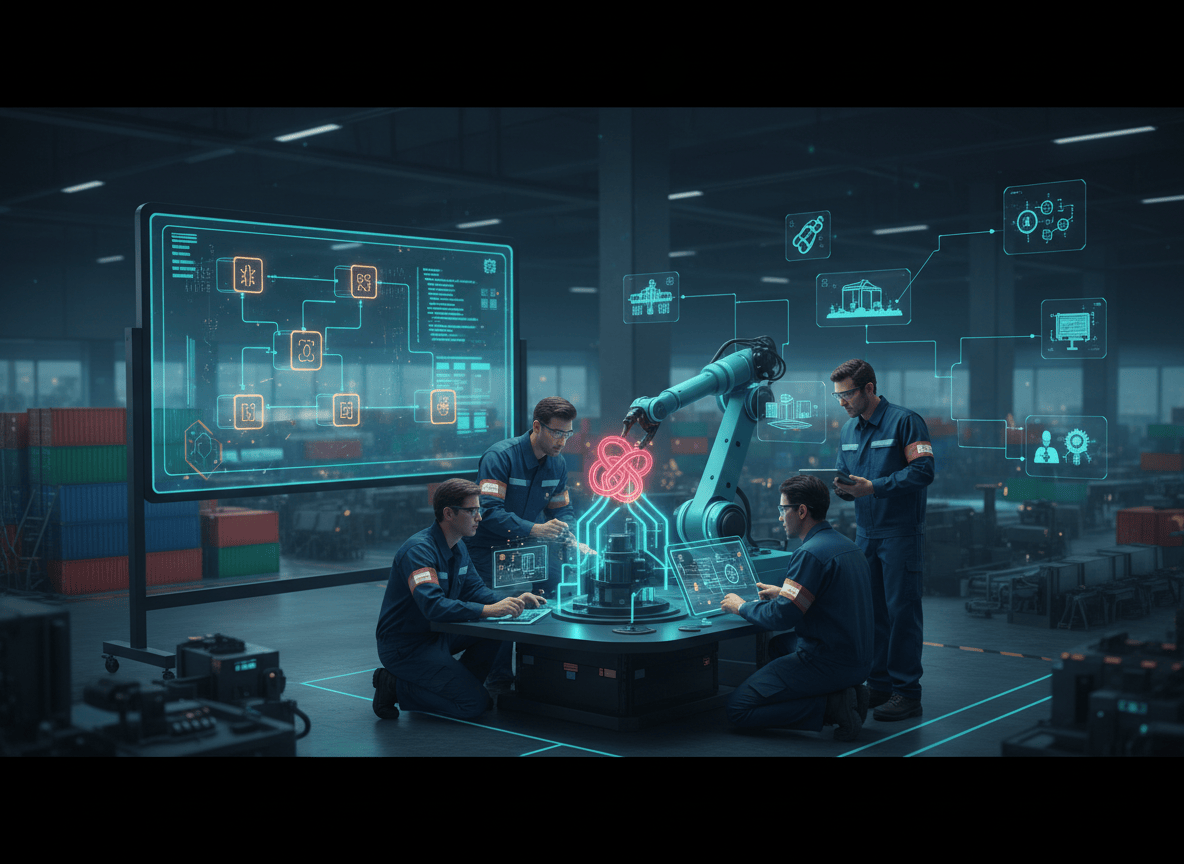
Forward-Deployed AI Engineering: Why Embedded Expertise Must Become a Reusable Learning System
Accenture and Google Cloud plan up to 1,000 embedded AI engineers. The strategic test is whether local delivery compounds into reusable patterns…

15 High-Impact AI Agent Use Cases in Manufacturing Operations
Explore 15 manufacturing AI agent use cases, from scheduling and quality follow-up to maintenance, energy, and approvals, with their intended business value.

AI Agent Architecture for Smart Manufacturing: Data, Reasoning, Tools, and Human Review
Understand six layers of manufacturing AI agent architecture: data, retrieval, reasoning, tools, human approval, and monitoring for controlled workflows.

NVIDIA’s Agentic AI Stack for Manufacturing: Omniverse, Isaac, Metropolis, NeMo, and NIM Explained
Explore how Omniverse, Isaac, Metropolis, NeMo, and NIM fit a manufacturing AI stack spanning simulation, vision, robotics, model services, and workflows.

What Is a Manufacturing AI Agent? From Dashboards to Autonomous Decisions
Learn what a manufacturing AI agent does, how it differs from dashboards and rule-based automation, and why data context, tools, and human…

AI Agents in Manufacturing: 15 Real Use Cases, Architecture, and ROI Examples
Learn how AI agents support manufacturing decisions through connected data, retrieval, tools, and human review, with use case ideas and value measures.