
Forward-deployed AI engineering is moving from a niche implementation role into a major enterprise delivery model. Accenture and Google Cloud have formed a dedicated group built around as many as 1,000 client-embedded engineers. My thesis is that proximity alone will not create durable value. The operating model succeeds only when local workflow knowledge is converted into governed, reusable assets and when the client can operate, evaluate, and improve the system after the embedded team leaves.
What changed: forward-deployed AI engineering scaled up
Business Insider reported on 9 September 2026 that the Accenture Gemini Enterprise Business Group will combine Google Cloud-skilled engineers with Accenture industry consultants, deploy up to 1,000 forward-deployed engineers, and expand Gemini Enterprise training to 50,000 Accenture employees. The Wall Street Journal independently reported the new unit and the plan for Google Cloud to help train the engineers. These are announced plans, not evidence that 1,000 deployments have already occurred or delivered measurable returns. (Business Insider, 9 Sep 2026; Wall Street Journal, 8 Sep 2026)
The initiative extends a direction Google Cloud described in April: forward-deployed engineers from Google and partners would work directly with customers on difficult technical problems and agent deployments. Google said its wider systems-integrator ecosystem included more than 330,000 people trained on Google AI technologies. That number is a vendor-reported workforce measure, not a count of experienced production operators. Training scale and delivery capability should therefore be measured separately. (Google Cloud, 22 Apr 2026)
For workload-value measurement, see our enterprise AI consumption-economics framework.
The strategic problem is familiar. AI pilots often work inside a protected demonstration but struggle when connected to fragmented data, exceptions, controls, and frontline incentives. An embedded engineer can shorten the distance between a business problem and a working system because the engineer observes the actual workflow. Yet the same intimacy can create one-off code, hidden dependencies, privileged access, and knowledge that remains with a small team. Speed at the site can become debt for the enterprise.
Why forward-deployed AI engineering matters now
Why does forward-deployed AI engineering matter now? Enterprise agents increasingly cross applications and make multi-step decisions, so implementation depends on process design, data semantics, identity, testing, and change management—not model selection alone. The 2025 DORA report found that AI amplifies the surrounding system of work and linked stronger outcomes to user focus, high-quality internal platforms, clear workflows, and fast feedback. The report is broader than consulting delivery, but its operating lesson applies directly. (DORA, 23 Sep 2025)
Five stages for a reusable AI learning system
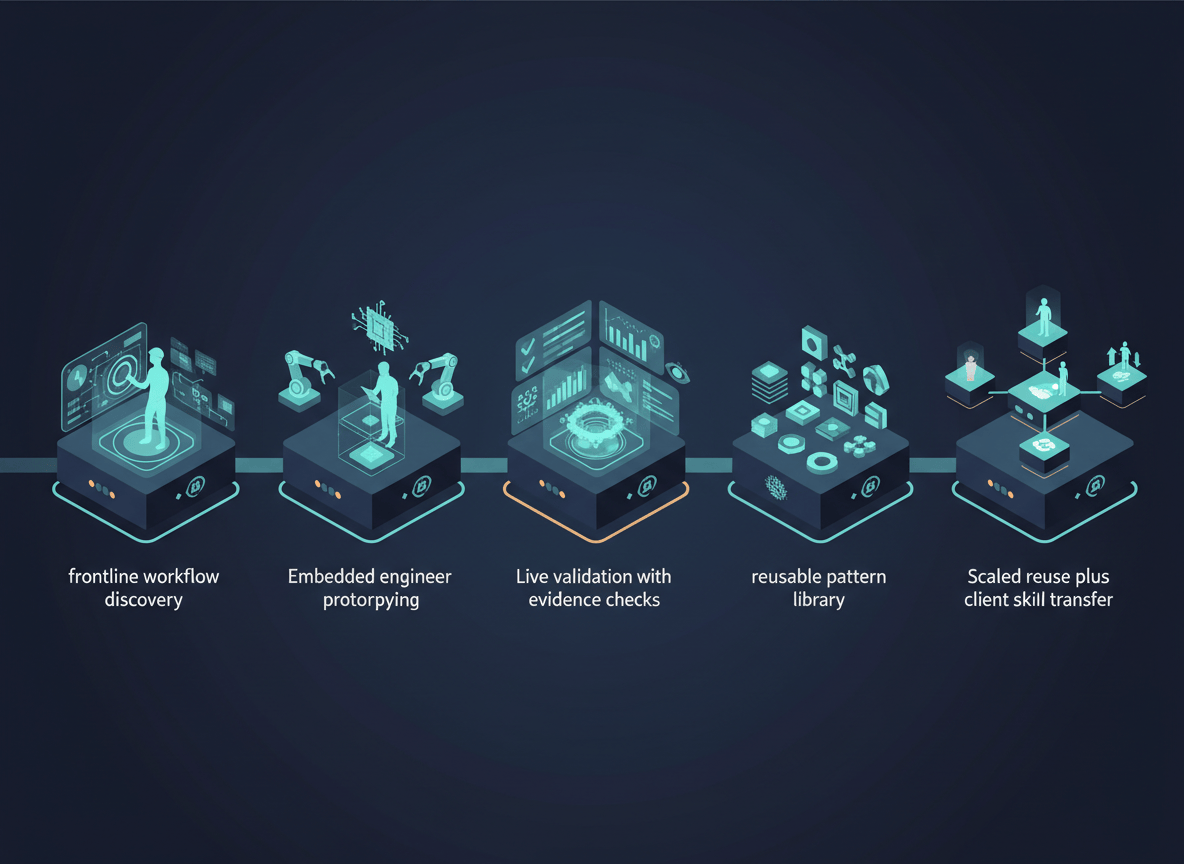
A reusable learning system has five stages. First, discover the real workflow and define the business outcome, constraints, and exception paths. Second, build a bounded solution with the client team inside approved data and authority limits. Third, validate behavior and operational value under live conditions. Fourth, extract reusable patterns, tests, interfaces, and governance evidence. Fifth, scale through an internal platform while transferring ownership, skills, and improvement routines to client operators.
Stage one starts with process truth. A polished requirements document rarely captures informal workarounds, queue behavior, escalation rules, and the reasons experienced employees ignore certain fields. Forward-deployed engineers should observe decisions at the point of work and create a versioned workflow map with system owners, data sources, latency requirements, failure costs, and prohibited actions. My view is that this map is the first reusable asset; the model or agent configuration comes later.
Stage two creates a bounded implementation contract. The first release should identify which data the system may read, which tools it may call, which outputs are advisory, and which actions require approval. It should also define the deployment environment, rollback path, and accountable owners. NIST’s AI Risk Management Framework is voluntary and technology-neutral, but its emphasis on incorporating trustworthiness into design, use, and evaluation supports this lifecycle discipline. Compliance claims should not be inferred from using the vocabulary. (NIST AI RMF, 26 Jan 2023)
Stage three proves performance where work actually happens. A valid test set should include routine cases, rare exceptions, changed data, access failures, adversarial inputs, latency spikes, and human override. Leaders should pair technical measures with operational measures such as cycle time, rework, missed commitments, exception volume, and adoption by the intended users. My interpretation is that an embedded team earns the right to scale only when results are repeatable across shifts, users, and realistic system conditions.
Stage four prevents customization from becoming a dead end. The team should separate client-specific policy from reusable platform components, then package connectors, prompts, schemas, evaluation suites, monitoring rules, security patterns, and runbooks with clear owners and versions. Every reusable component needs evidence about where it works and where it does not. Reuse without context spreads defects; customization without extraction repeats cost. The goal is disciplined variation around a stable internal platform.
For domain knowledge architecture, see our industry-specific AI agent analysis.
Stage five transfers capability. A forward-deployed team should leave behind more than code and dashboards: client engineers need deployment rights, documentation, evaluation data, incident procedures, cost visibility, and the ability to change the workflow safely. Exit criteria should include successful operation by the client team, not merely acceptance of the deliverable. If every material change requires the original consultants, the engagement has created dependency rather than organizational learning.
The five-stage model changes commercial incentives. Traditional services can reward effort, utilization, and project duration, while a learning-system model rewards time to validated outcome, reusable asset contribution, adoption, and client autonomy. My judgment is that contracts should include both local value measures and enterprise reuse measures. A team that solves one expensive problem is useful; a team that converts the solution into a trusted pattern for ten business units creates a different order of value.
My perspective and four implications
The first implication is that the unit of scale should be a verified pattern, not an engineer. Announcing 1,000 embedded specialists signals commitment, but headcount does not reveal how many workflows reach production or how much learning compounds. Leaders should track discovery-to-production conversion, time to stable operation, percentage of components reused, defects introduced through reuse, and the number of client teams able to maintain the solution without continued embedded support.
The second implication is that knowledge governance becomes a core architectural problem. Embedded teams see sensitive operational context, undocumented decision rules, and cross-system dependencies. Organizations need rules for what enters a shared pattern library, how client-specific data is removed, who reviews intellectual-property and confidentiality boundaries, and how obsolete guidance is retired. My view is that pattern provenance should include the originating context, approvals, test evidence, known limitations, and every later modification.
The third implication is that internal platforms become the bridge between bespoke work and scale. DORA’s 2025 research reported a correlation between high-quality internal platforms and an organization’s ability to unlock AI value. That does not prove a platform will fix weak delivery. It does suggest a practical design: give embedded teams paved paths for identity, data access, model choice, evaluation, observability, cost allocation, release, and rollback, while allowing explicit exceptions when the workflow requires them. (DORA, 23 Sep 2025)
The fourth implication concerns talent. A forward-deployed engineer needs software depth, systems thinking, domain curiosity, and the diplomacy to challenge a workflow without alienating its owners. Training 50,000 employees can widen familiarity, but a production role also requires supervised experience and decision rights. Leaders should distinguish awareness, certification, apprenticeship, and demonstrated operational competence. My interpretation is that senior client operators should be paired with engineers from the beginning, not invited only for final adoption. (Business Insider, 9 Sep 2026)
Counterargument and limits
A reasonable counterargument is that standardization can destroy the advantage of close-to-client work. Some processes are genuinely unique, and forcing every solution into a common template can slow delivery or erase competitive differentiation. The limitation also runs the other way: rapid field teams may bypass enterprise architecture and controls. The answer is not maximum reuse. It is an explicit decision about what must remain local, what can become a configurable pattern, and what should never be scaled.
Five leader actions
For resilient model operations, see our AI continuity architecture guide.
Leaders can take five actions. First, define a workflow evidence pack before deployment begins. Second, give field teams paved technical and governance paths with documented exception authority. Third, make production validation and client-operated recovery mandatory exit gates. Fourth, fund a pattern-curation team that reviews reuse, provenance, security, and retirement. Fifth, align provider and client incentives around validated outcomes, reusable learning, and declining dependency rather than headcount or pilot volume alone.
Conclusion: embedded expertise must compound
The conclusion is that forward-deployed AI engineering can close the gap between general technology and real operations, but it should be governed as a learning architecture. The Accenture-Google initiative makes the scale of this model visible. In my view, durable advantage will come from turning local observations into verified patterns, feeding those patterns into an internal platform, and transferring the ability to run and improve the system. Embedded expertise should leave the organization more capable, not merely more customized.
FAQ
What is forward-deployed AI engineering?
It is a delivery model in which engineers work closely inside a client environment to map workflows, integrate AI with real systems, build production solutions, and adapt them using direct operational feedback.
What did Accenture and Google Cloud announce?
They announced the Accenture Gemini Enterprise Business Group, with plans to train and deploy up to 1,000 forward-deployed engineers and expand Gemini Enterprise training to 50,000 Accenture employees.
How can organizations prevent one-off AI customization?
Separate client-specific policy from reusable connectors, schemas, tests, monitoring, security patterns, and runbooks; preserve provenance and limitations; and publish verified components through a governed internal platform.
Which metrics show that the model is working?
Track workflow-to-production conversion, time to stable operation, operational outcomes, exception and recovery performance, reuse with defect rates, client-operated deployments, and declining dependence on the original embedded team.
References
- Polly Thompson. “Accenture and Google Are Teaming Up to Send 1,000 Engineers Into the Field to Help Clients With AI.” Business Insider, 9 September 2026. Original source.
- Isabelle Bousquette. “Google Cloud, Accenture Launch Unit to Put AI Engineers On-Site With Customers.” The Wall Street Journal, 8 September 2026. Original source.
- Kevin Ichhpurani. “Building the Agentic Enterprise with Google Cloud Partners and a $750M Innovation Fund.” Google Cloud, 22 April 2026. Original source.
- Nathen Harvey; Derek DeBellis. “Announcing the 2025 DORA Report: State of AI-Assisted Software Development.” Google Cloud, 23 September 2025. Original source.
- National Institute of Standards and Technology. “AI Risk Management Framework.” NIST, 26 January 2023. Original source.
Leave a Reply