
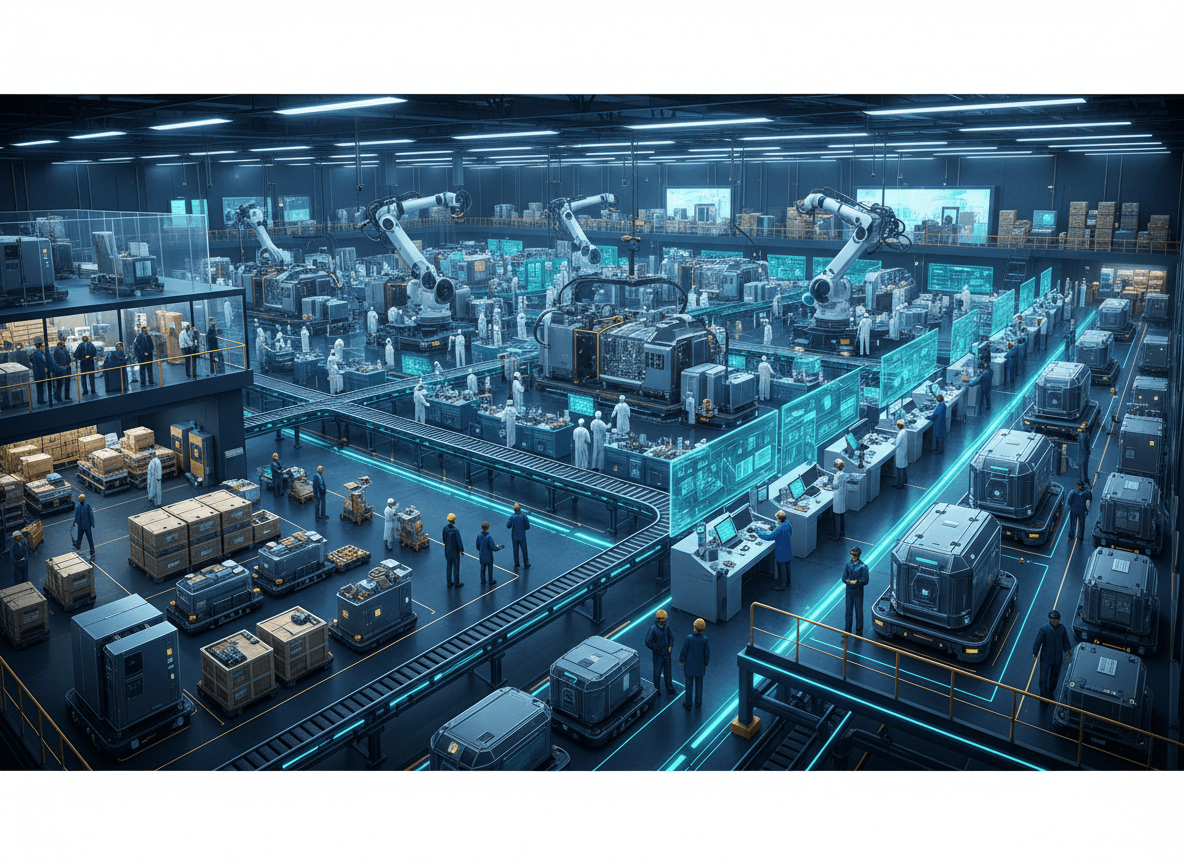
ASML’s September 8 groundbreaking at BIC North is easy to describe as capacity expansion: a second large production campus, about 35 hectares, room for as many as 20,000 workers over time, and a first phase that Reuters says is targeted for completion by 2029. But the more interesting public detail is the “Flow Factory,” which ASML says is intended to let the company build and assemble lithography systems faster and more efficiently. My thesis is that BIC North should be read not as a real-estate project but as a manufacturing operating-system redesign. Floor space creates options; synchronized flow, supplier readiness, qualification capacity, infrastructure and workforce convert those options into customer-ready output.
What changed
Reuters reported that construction began on September 8 at BIC North near Eindhoven Airport, around seven kilometers from ASML’s headquarters and main manufacturing operations in Veldhoven. The site is planned as a long-term, phased expansion. Reuters says the first phase will include offices, logistics and cleanroom space, while ASML’s public BIC North page describes a staged campus intended to add long-term flexibility rather than a one-time build-out. The municipality has also published the permit decision for the Flow Factory and related office space, and regional road works are being prepared to support access for employees, freight, public transport and cycling.
The demand backdrop is substantial. ASML reported €9.3 billion of Q2 2026 net sales and 86 new lithography systems sold in the quarter. Reuters, citing ASML’s July communication, said nearly all EUV production capacity was booked through the end of 2027. At the same time, major chipmakers are expanding advanced logic, memory and packaging capacity to serve AI computing demand. This creates a familiar manufacturing temptation: equate more buildings and cleanroom square meters with more capacity. In complex capital-equipment manufacturing, that is incomplete.
Why the Flow Factory matters now
A lithography system is not produced like a simple high-volume consumer product. It depends on sophisticated modules, specialized suppliers, precision assembly, cleanroom integration, software, calibration, test and customer-specific delivery readiness. When lead times and demand are high, queueing between these stages can become as important as the cycle time inside any one stage. A “Flow Factory” therefore matters because it implies an architectural question: how should material, modules, information, people and qualification resources move so that the whole system finishes faster and more predictably?
The public information does not disclose the detailed operating design, so any internal mechanics would be speculation. But the manufacturing logic is clear. If supplier modules arrive late, kitting is incomplete, assembly work is unbalanced, test capacity is constrained, or logistics interfaces are fragmented, a larger facility can hold more work-in-process without increasing customer output. Conversely, a factory that synchronizes readiness across modules can increase throughput with less waiting and less expediting even before every square meter is filled.

A manufacturing operating system, not just a building
My interpretation is that the Flow Factory should be governed through five linked “contracts.” First is a demand-and-capacity contract: what mix of systems and configurations must the network be ready to produce, and with what variability? Second is a module-readiness contract: which supplier and internal modules must be complete, qualified and available before a system enters a critical assembly stage? Third is a flow contract: how material, kitting, transport, cleanroom space and labor are synchronized to reduce queue time. Fourth is a qualification contract: how test, calibration and acceptance capacity scale with assembly output. Fifth is an infrastructure-and-workforce contract: power, roads, logistics, talent and support services must be ready on the same timeline as production assets.
These are not formal ASML terms; they are an operating-model lens derived from the public project facts. The point is that the factory’s effective capacity is the minimum of several dependent capabilities, not the sum of building area and installed equipment.
My perspective: manage conversion yield from space to shipped systems
In my view, the most useful strategic metric is not “capacity added” but conversion yield: how much planned physical and organizational capacity becomes stable, qualified, customer-ready throughput. That concept can be measured through a small set of operational indicators: supplier readiness at the release point, kit completeness, queue time between major stages, schedule adherence, cleanroom utilization, qualification bottlenecks, engineering rework, first-time-right acceptance and recovery time after disruptions.
The concept also connects directly to factory data architecture. If module status, logistics events, quality evidence and test readiness live in separate systems, leaders see local efficiency but miss end-to-end flow. A Flow Factory needs an information model that can answer a simple question continuously: what is preventing the next system from advancing safely to the next state? That is where smart manufacturing matters—not as another dashboard, but as a way to make constraints visible early enough to act.
Four strategic implications
First, real estate is option value, not output. A 35-hectare campus gives ASML room to grow, but the economic value arrives only when people, infrastructure, suppliers and qualification processes are synchronized. This makes phased development rational: each phase can be tied to validated demand and conversion capability rather than a single irreversible capacity jump.
Second, regional infrastructure becomes part of the production system. ASML’s public BIC North page says electrical supply arrangements are in place and notes grid expansion, while Eindhoven is preparing road and mobility improvements around the campus. For a complex equipment manufacturer, transport capacity, power availability and workforce accessibility are not “externalities”; they influence whether production capacity can actually operate.
Third, supplier scaling must be coordinated rather than merely increased. Advanced lithography depends on a dense high-tech ecosystem. If final assembly grows faster than the slowest qualified module or service capability, the system accumulates WIP. The right supplier conversation is therefore not only “can you make more?” but “can your readiness, quality evidence, change control and recovery capacity scale at the same cadence?”
Fourth, the factory becomes a learning system. Every delay, late module, test escape, engineering change and recovery event should improve the next production cycle. A new campus is an opportunity to design that learning loop into the operating model from the beginning rather than reproducing fragmented processes at larger scale.
Counterargument and limitations
The public record does not provide detailed Flow Factory layouts, cycle-time targets, productivity commitments or supplier-interface design. It would be inappropriate to infer exact savings or claim that the project guarantees faster output. ASML’s official BIC North page also emphasizes staged development and the need to complete legal and infrastructure processes. Demand itself can change, and the semiconductor equipment cycle remains capital-intensive and volatile. The right conclusion is not that BIC North automatically solves capacity constraints; it is that the project creates a rare opportunity to redesign how complex systems flow through manufacturing.
Actions for manufacturing leaders
- Define capacity as end-to-end qualified output, not installed assets or floor area.
- Map the critical readiness gates from supplier module to final acceptance and identify the constraint owner for each gate.
- Measure queue time and kit completeness alongside conventional utilization metrics.
- Tie infrastructure, workforce, logistics and test readiness to the same ramp governance as production equipment.
- Build a closed learning loop so every delay, quality issue and recovery event updates planning rules and future factory design.
Conclusion
BIC North is strategically important because it gives ASML long-term room to grow in the Brainport region. But the deeper manufacturing lesson extends far beyond one company. In complex equipment industries, expansion only becomes capacity when synchronized systems can repeatedly convert demand into qualified output. The Flow Factory idea is therefore most valuable when treated as a manufacturing operating system: one that coordinates modules, material, people, infrastructure, evidence and learning around the flow of the next customer-ready system.
FAQ
What is the strategic point of the Flow Factory?
Public reporting says the Flow Factory is intended to make assembly faster and more efficient. Strategically, that means reducing end-to-end constraints across modules, material flow, assembly, qualification and logistics—not simply adding floor space.
Does BIC North guarantee more output?
No. Buildings create capacity options. Output depends on synchronized supplier readiness, people, utilities, test and qualification resources, and stable operating processes.
Why are roads and power relevant to factory strategy?
Because complex manufacturing capacity cannot operate without reliable electricity, logistics and workforce access. For large campuses, regional infrastructure becomes part of the practical production system.
Which metrics should leaders watch during a ramp?
Supplier readiness, kit completeness, queue time, schedule adherence, qualification bottlenecks, engineering rework, first-time-right acceptance and recovery time provide a stronger picture than installed assets alone.
References
- Toby Sterling. “ASML breaks ground on new manufacturing facilities in major expansion.” Reuters, 8 September 2026. Original source.
- ASML. “Mogelijke ASML campus op BIC Noord.” Original source.
- ASML. “ASML reports €9.3 billion total net sales and €2.9 billion net income in Q2 2026.” 15 July 2026. Original source.
- Gemeente Eindhoven. “Start werkzaamheden wegenstructuur BIC Noord.” 14 July 2026. Original source.
- Gemeente Eindhoven. “Brainport Industries Campus.” Original source.
- Gemeente Eindhoven. “Besluit op aanvraag omgevingsvergunning: Realisatie van de Flow Factory.” 17 July 2026. Original source.
Related reading
- Agentic AI Production Readiness Gate
- Closed-Loop Industrial Decision Intelligence
- Why AI Pilots Scale Activity but Not P&L Value
Have a question or industry collaboration idea? Contact Industry AI Decision.
Leave a Reply