
Enterprise AI consumption economics should be judged by workload value, not usage growth alone. Snowflake’s latest results offer strong evidence that AI can accelerate demand for a data platform, but account counts, consumption, and revenue do not by themselves prove that customers are producing reliable, repeatable business outcomes. My view is that leaders now need a value-conversion system that links every important AI workload to quality, fully loaded cost, adoption behavior, and an operational or financial result.
What changed: AI accelerated Snowflake consumption
Snowflake reported on 2 September 2026 that second-quarter fiscal 2027 product revenue reached $1.49 billion, up 37 percent year over year, while total revenue was $1.55 billion. Remaining performance obligations were $9.00 billion, net revenue retention was 126 percent, and 828 customers generated more than $1 million in trailing twelve-month product revenue. These are company-reported results; Reuters independently reported the revenue beat and higher full-year product-revenue forecast. (Snowflake Q2 FY2027 results, 2 Sep 2026; Reuters, 2 Sep 2026)
Management attributed part of the acceleration to AI. Reuters reported that CEO Sridhar Ramaswamy said AI products contributed approximately half of the acceleration Snowflake was seeing. Snowflake said its coding assistant exceeded 9,100 accounts after adding more than 2,000 in the quarter, while its enterprise knowledge-work agent reached 5,800 accounts. The following day, the shares rose nearly 25 percent and lifted several software peers. That market response shows changed expectations, not proof of customer-level return on investment. (Reuters, 2 Sep 2026; Reuters, 3 Sep 2026)
For resilience across providers, see our AI model continuity architecture.
The economics are more complicated than a simple software-seat model. Snowflake recognizes product revenue as customers consume platform resources, so faster adoption can raise revenue while also increasing variable infrastructure, model, support, and governance demands. Its investor presentation explicitly identifies durable consumption, customers’ optimization behavior, AI credit pricing, and the predictability of platform consumption as business uncertainties. This makes the quality of consumption strategically important for both the platform and its customers. (Snowflake Q2 FY2027 investor presentation, 2 Sep 2026)
Why enterprise AI consumption economics matters now
Why does enterprise AI consumption economics matter now? AI agents can trigger searches, queries, model calls, data movement, retries, evaluations, and downstream actions at machine speed. A user may create more consumption without creating more value, especially when tasks loop, prompts expand, quality gates fail, or outputs are abandoned. Conversely, a more expensive model can be economically superior when it avoids rework or produces a higher-value decision. Leaders therefore need to measure the chain from request to outcome, not optimize tokens or credits in isolation.
Five stages from workload demand to verified value
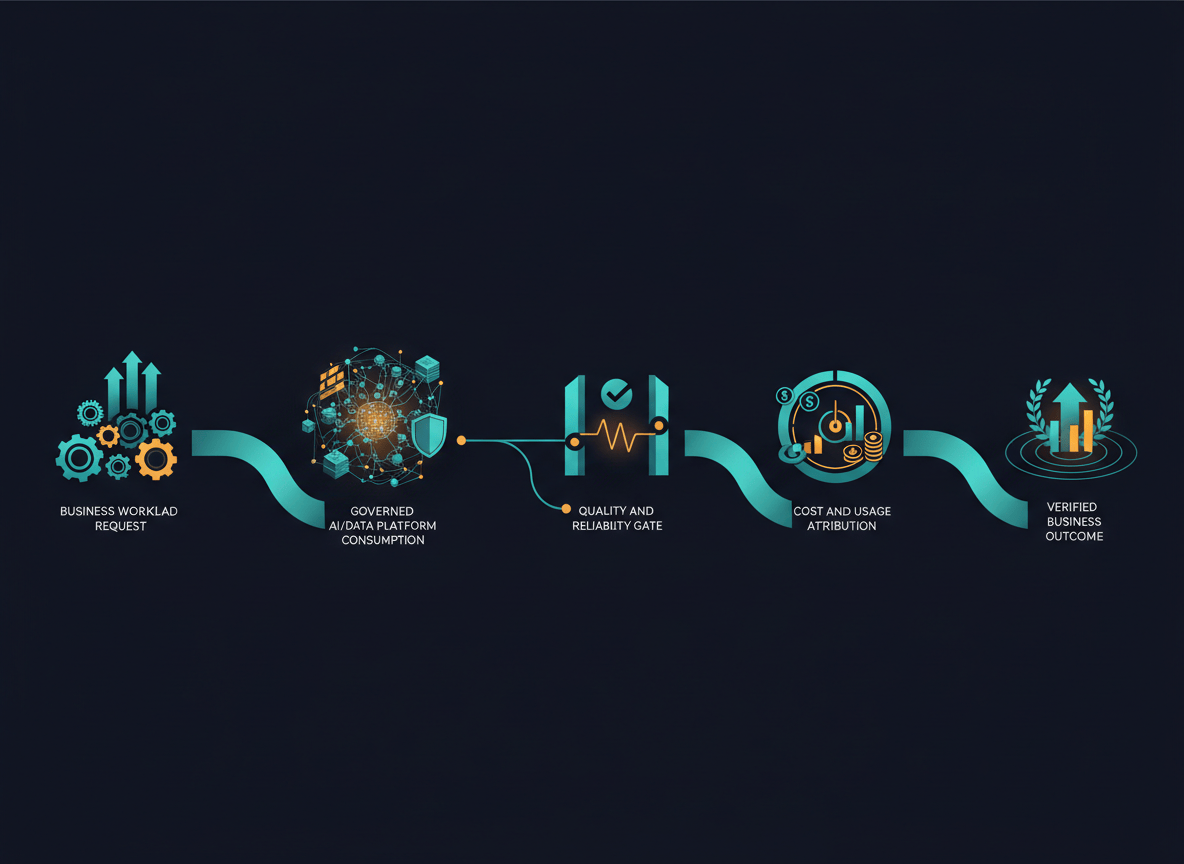
A practical value-conversion path has five stages. First, define the business workload and intended decision or action. Second, meter platform, data, and model consumption by workload and owner. Third, verify output quality, reliability, security, and human acceptance. Fourth, attribute fully loaded cost, including retries, orchestration, data preparation, support, and control overhead. Fifth, connect accepted outputs to a business result such as cycle-time reduction, resolved cases, improved forecast accuracy, higher throughput, or controlled revenue growth.
The workload definition is the unit of accountability. A request such as ‘deploy a customer-service agent’ is too broad for economic control. Leaders should specify the transaction, user, decision boundary, baseline process, required evidence, failure cost, and acceptable latency. A workload can then be segmented by complexity: retrieval, summarization, structured transformation, recommendation, or authorized action. My interpretation is that this taxonomy is more useful than organizing budgets around models, because models and routes will change while the business job remains.
Metering must preserve that workload context across the platform. Teams need tags or identities for business unit, product, environment, user class, agent, workflow, model route, data service, and release version. The FinOps Foundation recommends inventorying model-provider accounts and API keys, adding attribution through a proxy or observability layer, and building unit metrics such as cost per query, user, or workflow. Without consistent attribution, finance sees a bill, engineering sees telemetry, and business owners see adoption—but nobody owns the combined economics. (FinOps Foundation, updated 3 Jun 2026)
Quality is the economic gate between consumption and value. Useful measures include task success, factual or analytical accuracy, human override rate, escalation rate, policy compliance, latency, and the percentage of outputs used downstream. A workflow that produces twice as many responses may destroy value if reviewers reject half of them. My view is that leaders should report both gross consumption and accepted consumption, just as a factory distinguishes units started from good units shipped. That makes retries and low-quality automation visible.
Model routing is one operational lever, not the whole control system. Snowflake announced dynamic model routing on 18 August and said it can direct simpler tasks to more efficient models while reserving frontier models for harder work. The company reported internal tests showing up to three-times greater token efficiency for one pipeline-building evaluation and 25 percent greater token efficiency in another engineering test. These are vendor-attributed evaluations, not universal benchmarks; enterprises should reproduce them with their own workloads, quality thresholds, and cost data. (Snowflake, 18 Aug 2026)
For governance boundaries, see our enterprise AI control-plane guide.
Fully loaded cost must extend beyond model inference. It includes data engineering, storage, vector search, monitoring, safety checks, human review, incident response, integration maintenance, vendor commitments, and the opportunity cost of scarce engineering capacity. Some costs scale with requests, others with users, environments, or governance obligations. A sound model separates marginal cost from shared platform cost and shows both. Otherwise, a low token price can disguise an expensive workflow, while a shared platform can appear uncompetitive because common controls are charged to the first adopter.
Consider an industrial planning agent that summarizes demand changes, checks component constraints, and proposes a revised production plan. Consumption may rise as planners use it more often. Value is created only if recommendations meet quality thresholds, reduce planning cycle time, improve schedule stability, or prevent costly shortages without increasing control failures. The business case should therefore combine platform usage, accepted recommendations, planner interventions, exception rates, inventory impact, and service performance. This closes the loop between technical activity and operating results.
My perspective and four implications
In my view, the first implication is that consumption growth is an intermediate outcome. Investors may reasonably treat accelerating product revenue as evidence of demand, while customer executives still need proof that higher usage produces better economics. Platform vendors can help by exposing workload-level cost and quality controls. Customers must supply the baseline, outcome data, and decision rights. Neither side can complete the value equation alone, so commercial reviews should discuss workload economics rather than only credits, capacity, or feature adoption.
The second implication is that optimization changes product behavior. Lower prices or more efficient routing can stimulate additional use, and autonomous agents can reinvest saved capacity into more steps or more frequent execution. This rebound effect means savings should not be booked until leaders observe the new consumption pattern. My judgment is that budgets need explicit reinvestment rules: some efficiency gains should reduce spend, some should expand proven workloads, and experimental capacity should remain capped until quality and outcome evidence support scaling.
The third implication is organizational. Enterprise AI economics crosses product, data, engineering, finance, procurement, security, risk, and business operations. A central team can set measurement standards and negotiate platform terms, but workload owners must remain accountable for outcome value. The operating cadence should resemble a portfolio review: compare actual unit economics with the baseline, investigate quality loss or runaway consumption, decide whether to route, redesign, retrain, scale, or stop, and retain an audit trail of assumptions and decisions.
The fourth implication concerns vendor evaluation. A platform that lowers unit cost but fragments governance, moves data unnecessarily, or increases integration work may not improve total economics. Conversely, an integrated platform may justify a premium if it reduces engineering effort, speeds deployment, or improves control evidence. Leaders should test alternatives on representative workloads and include migration effort, portability, reliability, and switching cost. My interpretation is that purchasing the cheapest model call is often different from designing the lowest-cost reliable business process.
Counterargument and limitations
A reasonable counterargument is that Snowflake’s 37 percent product-revenue growth, 126 percent net retention, and expanding large-customer base already demonstrate successful value creation. They are meaningful commercial indicators, and the company also reported a 74.7 percent non-GAAP product gross margin. The limitation is attribution: aggregate results cannot show which AI workloads are durable, profitable, safe, or outcome-positive for an individual customer. This article does not dispute the results; it argues that leaders should avoid using platform growth as a substitute for their own workload evidence. (Snowflake Q2 FY2027 results, 2 Sep 2026)
Five leader actions
For investment discipline, see our AI portfolio-governance framework.
Leaders can take five actions. First, select ten material AI workloads and document baseline cost, quality, time, and outcome. Second, enforce workload identities across platform, data, model, and business telemetry. Third, create accepted-consumption metrics that exclude failed, abandoned, or policy-rejected outputs. Fourth, run controlled routing and architecture tests using fully loaded cost and fixed quality thresholds. Fifth, hold monthly portfolio reviews with authority to scale, redesign, renegotiate, or stop workloads when evidence contradicts the original thesis.
Conclusion: govern AI workloads as production economics
The conclusion is that enterprise AI consumption economics is becoming the bridge between software growth and operating value. Snowflake’s results provide credible evidence that AI is driving platform demand, and its routing announcement shows one way to improve efficiency. Neither eliminates the customer’s measurement obligation. In my view, the next enterprise advantage will come from treating every important AI workload as a governed production system—metered by owner, accepted through quality gates, costed end to end, and scaled only when business outcomes survive scrutiny.
FAQ
What is enterprise AI consumption economics?
It is the discipline of linking each AI workload’s usage to accepted quality, fully loaded cost, and a verified business outcome rather than treating tokens, credits, or account counts as value by themselves.
What did Snowflake report for Q2 fiscal 2027 product revenue?
Snowflake reported $1.49 billion in product revenue, representing 37 percent year-over-year growth, for the quarter ended 31 July 2026.
Why is model routing not enough to control AI economics?
Routing can reduce unnecessary use of expensive models, but leaders still need workload identity, quality gates, full cost attribution, outcome measurement, and rules for scaling or stopping work.
Which metrics should leaders track?
Useful metrics include gross and accepted consumption, task success, human override and escalation rates, cost per accepted outcome, cycle time, reliability, policy compliance, and the business result relative to baseline.
References
- Anzar Mehraj. “Snowflake Lifts Annual Revenue Forecast on Cloud and AI Demand, Shares Soar.” Reuters, 2 September 2026. Original source.
- Rashika Singh. “Snowflake’s AI-Powered Results Send Shares Soaring, Buoy Software Stocks.” Reuters, 3 September 2026. Original source.
- Snowflake. “Snowflake Reports Financial Results for the Second Quarter of Fiscal 2027.” Snowflake Investor Relations, 2 September 2026. Original source.
- Snowflake. “Investor Presentation — Second Quarter Fiscal 2027.” Snowflake Investor Relations, 2 September 2026. Original source.
- Snowflake. “Snowflake Unlocks Better AI Economics with Dynamic Model Routing, Delivering More Value to Customers.” Snowflake, 18 August 2026. Original source.
- FinOps Foundation contributors. “Tokenomics: Managing AI Value in SaaS Model Token Costs.” FinOps Foundation, Updated 3 June 2026. Original source.
Leave a Reply