
Analog Devices’ agreement to acquire Alif Semiconductor is strategically interesting because it connects analog sensing and signal processing with low-power AI processing at the edge. Yet a broader portfolio is not automatically a platform. My thesis is that edge AI acquisition integration creates value only when the combined company delivers a qualified sensor-to-action architecture: coherent hardware, software, security, lifecycle support, reference designs, and evidence that customers can deploy local intelligence faster and more reliably.
What changed: ADI agreed to acquire Alif
Analog Devices and Alif announced on 9 September 2026 a definitive all-cash agreement under which ADI would pay $1.35 billion upfront, with potential contingent consideration of up to $200 million. The company release says the transaction is expected to close before the end of calendar 2026, subject to customary conditions and the applicable U.S. antitrust waiting period. Reuters independently confirmed the main terms. This is a signed agreement, not a completed acquisition. (Analog Devices and Alif, 9 Sep 2026; Reuters, 9 Sep 2026)
The announced logic combines ADI’s sensing, signal processing, power, connectivity, and application software with Alif’s AI-native microcontrollers and fusion processors. The release describes applications across industrial, data-center infrastructure, defense, energy, robotics, digital health, and wearables. It also says Alif silicon is already shipping with consumer and industrial design wins. These are company-attributed claims; the public sources do not disclose Alif revenue, customer concentration, margins, or program-level qualification status. (Analog Devices and Alif, 9 Sep 2026; Embedded Computing Design, 9 Sep 2026)
For physical-AI control boundaries, see our execution-contract framework.
Alif’s Ensemble product page illustrates the technical adjacency. The family scales across Arm-based processors, includes dedicated microNPUs, integrates on-die memory and interfaces, and offers secure boot and lifecycle management. Alif states that configurations reach more than 250 GOPS and use power management that activates only required resources. Those specifications describe available products, not the performance of a future combined ADI solution. Integration must still prove system behavior, tools, and economics. (Alif Ensemble product page, accessed 10 Sep 2026)
Why edge AI acquisition integration matters now
Why does edge AI acquisition integration matter now? Industrial systems increasingly need to interpret motion, vibration, sound, temperature, images, and radio signals close to the physical process. Local processing may reduce latency, bandwidth, and cloud dependence, but it also inherits tight power, safety, reliability, and product-lifecycle constraints. Customers do not buy a strategy slide; they qualify components, software, security, packaging, documentation, supply, and field support as one dependable system.
Five stages from physical signal to bounded action
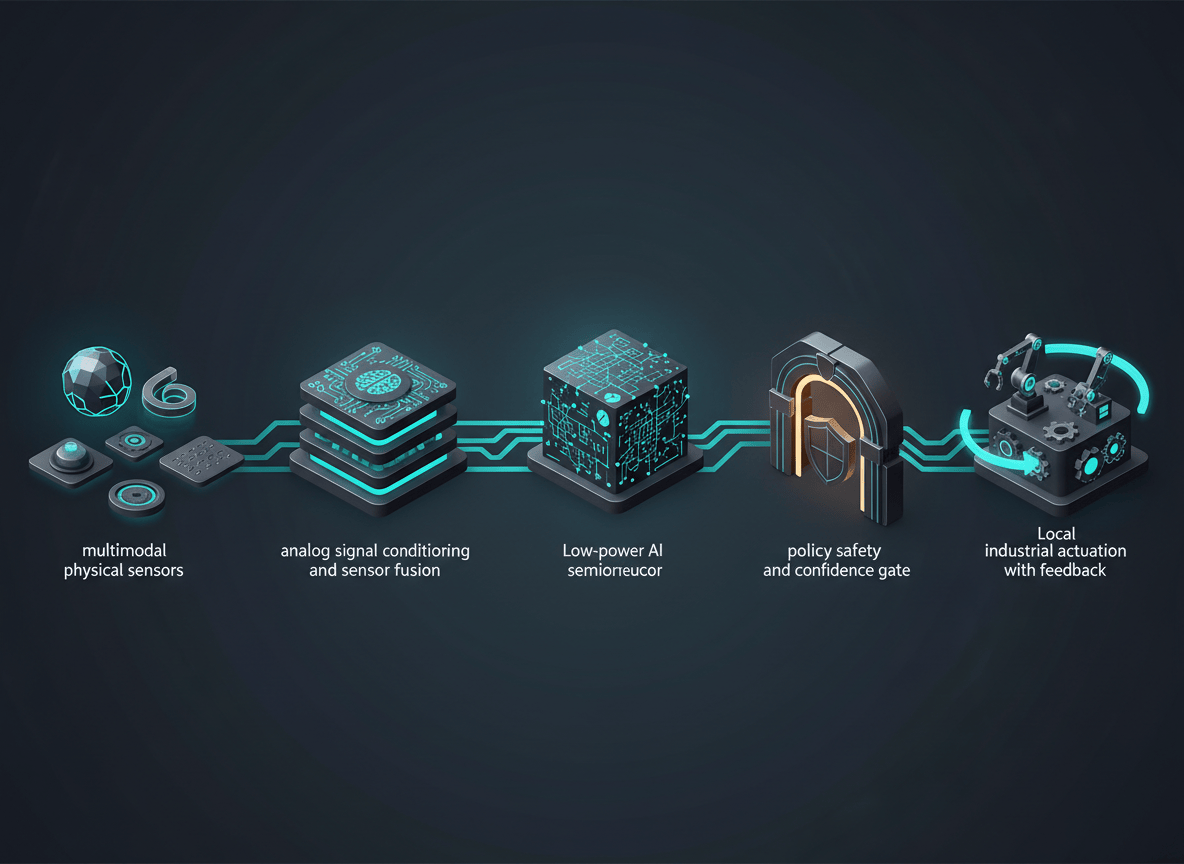
A sensor-to-action integration program has five stages. First, acquire trustworthy physical signals through suitable sensors and analog front ends. Second, condition, synchronize, and fuse those signals into decision-ready data. Third, run efficient inference on a qualified edge processor. Fourth, apply confidence, security, policy, and safety gates. Fifth, command local actuation and return field evidence to engineering. The acquisition creates adjacency across these stages, but integration must make the transitions repeatable.
The first stage is signal integrity. Sensor accuracy, calibration, noise, sampling, drift, and environmental limits determine what the model can know. A stronger processor cannot recover information that was never captured or was distorted upstream. ADI’s established analog portfolio may give the combined organization an important design position, but my interpretation is that product teams must publish complete error budgets and reference conditions rather than presenting AI performance independently of the physical signal chain.
The second stage is conditioning and fusion. Different signals arrive at different rates, resolutions, and trust levels. Timing, filtering, conversion, synchronization, and feature extraction must be engineered together before inference. This layer is where analog and digital teams often use different tools and measures. Leaders should create shared system models, interfaces, and validation data so that sensor changes can be traced to model behavior. The platform advantage comes from shortening this cross-disciplinary loop.
The third stage is efficient inference. Alif says its heterogeneous architecture combines real-time cores, application processors in some configurations, dedicated neural processing, memory, interfaces, power management, and security. That breadth can support local AI under constrained power and latency. However, peak GOPS is not application throughput. Customers need model conversion, operator support, memory fit, deterministic timing, accuracy after quantization, thermal performance, energy per decision, debugging, and long-term tool compatibility. (Alif Ensemble product page, accessed 10 Sep 2026)
The fourth stage turns model output into an authorized decision. A probability score should not directly move a robot, alter a dose, open a lock, or shut down equipment. The platform needs confidence thresholds, state validation, permissions, fail-safe behavior, human override where appropriate, and a record of why the action was allowed. My view is that this policy gate is the missing bridge between impressive edge inference and deployable physical intelligence.
For semiconductor portfolio decisions, see our custom-silicon governance analysis.
The fifth stage closes the operational loop. Actuation needs deterministic interfaces, bounded commands, feedback sensing, exception handling, and recovery. Field telemetry should show false positives, missed events, latency, energy, environmental conditions, software versions, security state, and downstream effects. That evidence must return to hardware, model, and application teams without exposing customer secrets. A sensor-to-action platform is valuable because it improves the complete loop, not because one component benchmarks well.
The transaction adds an integration challenge as well as an opportunity. Product roadmaps, sales incentives, support systems, software tools, security processes, quality methods, and lifecycle commitments must converge without disrupting current customers. The official release lists inability to retain key personnel, integration difficulty, and failure to realize expected benefits among transaction risks. Those cautions are standard, but they identify the real management work. Financial close is only the legal start of platform creation. (Analog Devices and Alif, 9 Sep 2026)
My perspective and four implications
The first implication is that reference designs become a strategic asset. Combining a sensor, signal chain, processor, model, security configuration, power design, and actuator interface into a validated pattern can reduce customer engineering risk. My judgment is that the combined company should prioritize a small number of high-value scenarios—such as predictive maintenance, machine vision, condition monitoring, or wearable sensing—and publish measured system envelopes instead of producing an unstructured catalogue of compatible parts.
The second implication is that software integration may determine whether hardware adjacency produces revenue. Customers will evaluate compilers, model import, drivers, middleware, debugging, secure provisioning, over-the-air update, fleet monitoring, and example applications. If separate toolchains remain, the acquisition may expand choice while increasing friction. Leaders should define one developer journey and measure time from sensor data capture to a validated on-device decision, including the effort needed to diagnose failure across analog and digital layers.
The third implication concerns qualification and lifecycle. Industrial, medical, energy, and defense designs can remain in service far longer than consumer software cycles. Product continuity, change notification, traceability, functional-safety evidence, cybersecurity maintenance, second-source strategy, and long-term tool support affect the customer’s decision. My view is that integration plans should preserve existing commitments while creating a transparent migration path. Premature consolidation can destroy trust even when the target architecture is stronger.
The fourth implication is commercial. A broader portfolio can improve cross-selling, but attaching more components to every design is not the same as solving the customer’s system problem. Teams should track reference-design adoption, design-win conversion, customer engineering time saved, qualified content per system, software usage, field reliability, and support burden. The $1.35 billion purchase price is a verified transaction term; any revenue synergy, margin benefit, or market-share outcome remains a forecast until operating evidence accumulates. (Wall Street Journal, 9 Sep 2026)
Counterargument and limits
A reasonable counterargument is that customers may prefer best-of-breed components from multiple suppliers and resist an integrated stack. That is plausible, especially where open interfaces preserve bargaining power and technical flexibility. Another limit is that cloud or gateway processing may be more economical for some workloads. The combined portfolio should therefore support modular adoption. The test is not whether every sensor uses an Alif processor, but whether integration lowers total engineering and lifecycle risk where local intelligence is justified.
Five leader actions
For equipment qualification, see our semiconductor conversion-yield framework.
Leaders can take five actions. First, select priority sensor-to-action scenarios and define measurable system envelopes. Second, create one cross-company architecture council for signal integrity, inference, safety, security, and lifecycle. Third, unify the developer journey while maintaining clear migration and support commitments. Fourth, qualify complete reference designs under realistic power, latency, environmental, and failure conditions. Fifth, report integration progress through customer time-to-decision, conversion, reliability, reuse, and field economics—not product count or claimed addressable market alone.
Conclusion: qualify the complete loop
The conclusion is that Analog Devices’ proposed Alif acquisition could strengthen an important edge AI position, but portfolio adjacency is only the opening condition. In my view, durable advantage will come from proving a sensor-to-action platform in which physical signals remain trustworthy, inference is efficient, decisions are gated, actuation is bounded, and field evidence improves the next design. The transaction closes on paper; integration succeeds when customers can qualify and operate the complete loop.
FAQ
What did Analog Devices agree to acquire?
Analog Devices agreed to acquire privately held Alif Semiconductor in an all-cash transaction for $1.35 billion upfront, with potential contingent consideration of up to $200 million, subject to closing conditions.
Why is the deal relevant to edge AI?
It would combine ADI sensing, signal processing, power, connectivity, and software with Alif AI-native microcontrollers and fusion processors designed for low-power on-device inference and sensor fusion.
What is a sensor-to-action platform?
It is a qualified system that preserves signal integrity, conditions and fuses data, runs efficient local inference, applies safety and policy gates, controls bounded actuation, and returns field evidence for improvement.
How should leaders measure acquisition integration?
Measure reference-design adoption, developer time to a validated decision, design-win conversion, software usage, qualification progress, lifecycle continuity, field reliability, support burden, reuse, and customer operating economics.
References
- Analog Devices, Inc.; Alif Semiconductor. “Analog Devices to Acquire Alif Semiconductor, Adding an AI-Native Processing Platform to Advance Physical Intelligence for the Next Generation of Real-World Systems.” PR Newswire, 9 September 2026. Original source.
- Anhata Rooprai. “Analog Devices to Buy Alif Semiconductor for $1.35 Billion.” Reuters, 9 September 2026. Original source.
- Connor Hart. “Analog Devices to Acquire Alif Semiconductor for $1.35 Billion.” The Wall Street Journal, 9 September 2026. Original source.
- Chad Cox. “Analog Devices Acquires Alif Semiconductor to Advance Physical Intelligence Solutions.” Embedded Computing Design, 9 September 2026. Original source.
- Alif Semiconductor. “Ensemble E1, E3, E5, E7 for Edge AI 32-Bit Microcontrollers.” Alif Semiconductor, Accessed 10 September 2026. Original source.
Leave a Reply