
d-Matrix plans to connect Raptor inference processors to NVIDIA rack infrastructure through NVLink Fusion. The strategic test is qualified service, not interface access.
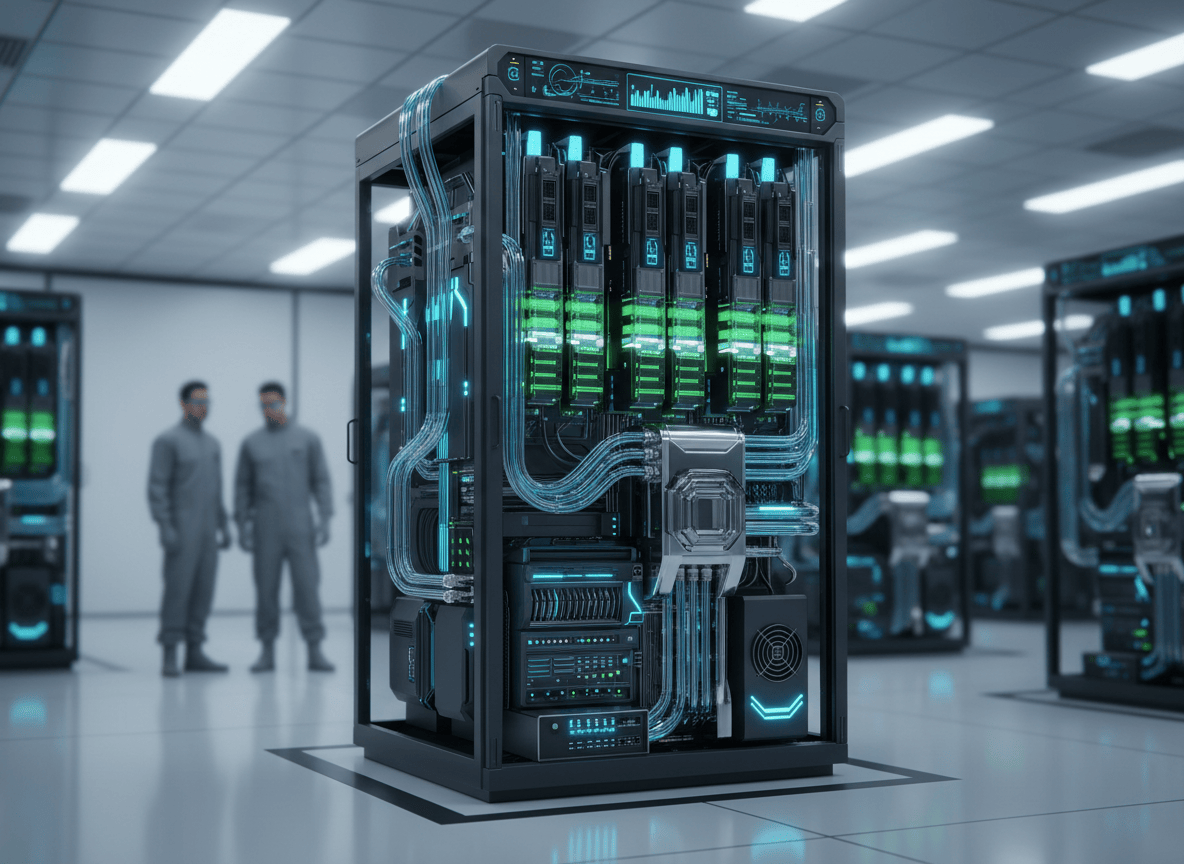
AI inference rack integration is emerging as the commercialization test for alternative accelerators. d-Matrix announced on 10 September 2026 that its next-generation Raptor inference processors will connect to NVIDIA’s rack-scale infrastructure through NVLink Fusion, with Astera Labs helping on custom connectivity. My thesis is that interface access reduces integration risk but does not create deployable throughput. Operators still must qualify memory movement, software partitioning, power, cooling, observability, recovery, and workload economics as one production system. (d-Matrix, 10 Sep 2026; Reuters, 10 Sep 2026)
What changed: d-Matrix joined an NVIDIA rack-scale path
Reuters reported that Raptor is scheduled to complete final design by the end of 2026 and that compatible racks are expected in 2027. d-Matrix’s release gives a more specific initial-availability target of the fourth quarter of 2027. These dates are company expectations, not shipped-system facts. The startup says the collaboration targets latency-sensitive services such as coding assistants, chatbots, and voice agents; financial terms were not disclosed. That distinction matters when leaders evaluate a roadmap rather than an installed platform. (Reuters, 10 Sep 2026; d-Matrix, 10 Sep 2026)
The proposed architecture combines Raptor XPUs with NVIDIA MGX rack designs, Vera CPUs, NVLink switches, BlueField DPUs, ConnectX SuperNICs, and Spectrum-X networking. d-Matrix says Raptor uses a memory-centric design with stacked DRAM and SRAM compute, while the rack can separate inference phases so GPUs handle compute-intensive prefill and XPUs handle latency-sensitive decode. These are technical design claims. End-to-end performance, efficiency, availability, and cost must be demonstrated on representative systems and workloads. (d-Matrix, 10 Sep 2026)
Why AI inference rack integration matters now
Training is episodic, but deployed agents can generate continuous demand with strict latency and service-level expectations. The processor may be optimized for a narrow phase, yet tokens move through CPUs, accelerators, memory, switches, network interfaces, storage, schedulers, and cooling systems before reaching a user. The slowest or least reliable component determines the service. A fast chip inside an immature rack is still an immature production offering.
NVIDIA’s own launch commentary makes the system problem explicit: building an XPU is only the first step, while rack-scale deployment also requires networking, power, cooling, software, supply, interface validation, and rack certification. NVLink Fusion may provide a lower-risk path into a mature architecture, but the vendor still controls significant layers of the platform. My view is that adoption should be assessed as a qualification program with evidence gates, not as proof of interoperability from a connector announcement. (NVIDIA, 10 Sep 2026)
Five stages from chip compatibility to deployable throughput
A five-stage qualification path can turn interface compatibility into operating evidence. First, prove accelerator and memory topology under the target model. Second, validate scale-up and scale-out data movement. Third, qualify runtime, partitioning, and scheduling behavior. Fourth, certify rack power, thermal, observability, and service procedures. Fifth, demonstrate stable workload throughput, recovery, and total economics at production concurrency. Each stage should have acceptance criteria, owners, test artifacts, and a rollback decision.
Stage one is workload-to-memory fit. Raptor’s proposed stacked-memory approach is intended to reduce data movement for inference, but operators need evidence for model size, context length, key-value cache behavior, precision, batching, and memory fragmentation. Peak bandwidth or capacity does not show whether the deployed model sustains its accuracy and latency targets. My interpretation is that qualification should begin with a small set of economically important workloads and record every model, compiler, firmware, and memory configuration.
Stage two is fabric behavior. Scale-up links must move data among processors with predictable latency, congestion, and error handling; scale-out networks must maintain service across racks. Astera Labs is named as a partner for custom high-speed data paths, but production teams must test topology, collective or point-to-point traffic, oversubscription, cable and connector faults, switch resets, and degraded modes. An interconnect standard can enable communication without guaranteeing balanced performance under real request patterns.

Stage three is software partitioning. d-Matrix describes a heterogeneous inference model in which GPUs may handle prefill while XPUs accelerate decode. That can improve resource specialization, but it adds routing, memory-transfer, scheduler, telemetry, and fallback complexity. The runtime must decide where work executes, preserve context across phases, manage incompatible queues, and respond when one resource saturates. My view is that the software contract should expose placement decisions and transfer costs rather than present the rack as a single opaque accelerator.
Stage four is rack qualification. Power delivery, liquid cooling, airflow, thermal transients, firmware, service access, spare strategy, and supply-chain certification affect usable capacity. NVIDIA says its MGX ecosystem can shorten the path to deployment, while d-Matrix emphasizes modular cable-free trays. Those are plausible platform benefits, not evidence that a future Raptor rack has passed customer qualification. Operators should test at full power, partial failure, maintenance conditions, and the environmental envelope of the intended facility. (NVIDIA, 10 Sep 2026; HPCwire, 10 Sep 2026)
Stage five is production service evidence. Operators should measure time to first token, time per output token, throughput at target concurrency, tail latency, energy per accepted token, quality retention, error rate, recovery time, and cost per completed workload. MLCommons’ MLPerf Inference v5.0 introduced interactive LLM measurements with explicit latency requirements, illustrating the value of architecture-neutral, reproducible tests. A procurement decision still needs customer-specific models, software, data, and reliability conditions beyond any public benchmark. (MLCommons, 2 Apr 2025)
Qualification continues after deployment. Firmware, compiler, model, networking, and scheduler changes can alter the balance among prefill, decode, memory, and fabric traffic. A change-control system should identify affected workloads, rerun critical tests, compare performance and quality, and preserve a known-good rollback. My inference is that heterogeneous racks need stronger configuration lineage than homogeneous systems because one update can move the bottleneck to a different component without causing an obvious functional failure.
My perspective and four implications
First, the unit of procurement becomes the service envelope, not the chip. Buyers should contract for defined models, context distributions, concurrency, latency percentiles, quality thresholds, availability, energy, and recovery behavior. A processor benchmark can help screen options, but it cannot substitute for the full envelope. My judgment is that vendors able to publish reproducible rack-level evidence will gain trust faster than vendors relying on component specifications or theoretical integration narratives.
Second, openness has layers. NVLink Fusion expands participation inside NVIDIA infrastructure, which may increase accelerator choice while retaining dependency on NVIDIA rack, networking, software, and certification decisions. That is not inherently negative; shared infrastructure can reduce time and risk. Leaders should nevertheless map control points, licensing, roadmap coupling, second-source options, diagnostic access, and exit costs. A semi-custom ecosystem is more open than a closed accelerator, but it is not the same as a vendor-neutral platform.
Third, the organizational unit becomes an integration office. Chip, systems, network, thermal, software, site-reliability, and procurement teams often approve different pieces on different calendars. A future 2027 system needs one integration office that owns the end-to-end service envelope and the evidence backlog. My view is that roadmap gates should require cross-functional sign-off at topology freeze, first rack, workload qualification, failure testing, and production acceptance. Otherwise, each component can pass while the service misses its objective.
Fourth, economics depend on accepted service, not peak tokens. Disaggregating prefill and decode may improve utilization, but savings depend on transfer overhead, queue balance, utilization across demand cycles, software labor, spare pools, power, and failure domains. Leaders should model the cost of idle specialized resources and the operational burden of maintaining two accelerator stacks. The relevant denominator is accepted, quality-preserving tokens delivered within the service-level objective over the rack’s useful life.
Counterargument and limits
A reasonable counterargument is that mature rack standards and partner ecosystems already absorb most integration work, so individual buyers should not recreate certification. Reuse is valuable, and common hardware can shorten deployment. The limit is that vendor qualification proves a reference configuration, not every model, concurrency pattern, facility, or reliability target. Another risk is timing: a platform expected in late 2027 may face different competing architectures and workloads. Buyers should stage commitments and preserve exit options until evidence matures.
Five leader actions
Leaders can take five actions. First, define two or three representative inference service envelopes before selecting hardware. Second, create a cross-vendor evidence matrix covering memory, fabric, runtime, rack, and operations. Third, require transparent partitioning, telemetry, degraded-mode, and rollback behavior. Fourth, run acceptance tests at production concurrency, tail latency, power, and failure conditions. Fifth, tie commercial commitments to tape-out, first-system, qualification, and service milestones rather than treating interface adoption as completed deployment.
Conclusion: qualify the complete service path
d-Matrix joining the NVLink Fusion ecosystem could broaden inference-accelerator choice and lower the cost of reaching a mature rack architecture. It also makes the remaining work more visible. In my view, sustainable advantage will come from qualifying the complete path from model and memory through fabric, runtime, cooling, observability, and recovery. Chip access is an enabling condition; deployable throughput is an operating result that customers should be able to reproduce.
FAQ
What did d-Matrix announce on 10 September 2026?
d-Matrix announced that its next-generation Raptor inference XPUs will integrate with NVIDIA rack-scale infrastructure through NVLink Fusion, with Astera Labs contributing custom connectivity solutions.
When are the Raptor-based racks expected?
d-Matrix says Raptor is expected to tape out before the end of 2026 and that initial Raptor XPUs integrated into NVIDIA MGX racks are expected in the fourth quarter of 2027.
Why does interface compatibility not guarantee deployable throughput?
Production service also depends on workload-to-memory fit, scale-up and scale-out data movement, runtime partitioning, power and thermal behavior, observability, failure recovery, quality, and cost at realistic concurrency.
Which metrics should buyers use for inference racks?
Use model-specific quality, time to first token, time per output token, throughput at target concurrency, tail latency, energy per accepted token, availability, recovery time, utilization, and lifecycle cost.
References
- Anhata Rooprai; Stephen Nellis. “Chip Startup d-Matrix to Use Nvidia Chip-Linking Tech in AI Servers.” Reuters, 10 September 2026. Original source.
- d-Matrix. “d-Matrix Adopts NVIDIA NVLink Fusion Rackscale Infrastructure for Ultra-Low Latency AI Inference.” 10 September 2026. Original source.
- Jesse Clayton. “d-Matrix Adopts NVIDIA NVLink Fusion for Rack-Scale XPU Deployment.” NVIDIA Blog, 10 September 2026. Original source.
- d-Matrix. “d-Matrix and NVIDIA Plan NVLink Fusion Rack System for AI Inference.” HPCwire, 10 September 2026. Original source.
- MLCommons. “MLCommons Releases New MLPerf Inference v5.0 Benchmark Results.” 2 April 2025. Original source.
Related reading
- NVIDIA Agentic AI Infrastructure
- AI Workload Value and Governance
- Why AI Projects Fail Without Data Context
Have a question or industry collaboration idea? Contact Industry AI Decision.
Leave a Reply